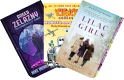
I moved to Ireland this year, and was drawn to a number of Irish authors. Obviously it’s not always a good idea to follow the crowd, but all the praise for Keegan’s novella is well-earned. Set in the town of New Ross in the run-up to Christmas 1985, it tells the story of Bill Furlong, an ordinary, hard-working man, who makes a discovery that forces him to decide what kind of man he is. The story of a good man doing the right thing, it’s one of the most powerful stories I’ve read on many years. There is not a misplaced sentence in the book. This is a masterpiece.
"A hypnotic and electrifying Irish tale that transcends country, transcends time." —Lily King, New York Times bestselling author of Writers & Lovers
Small Things Like These is award-winning author Claire Keegan's landmark new novel, a tale of one man's courage and a remarkable portrait of love and family
It is 1985 in a small Irish town. During the weeks leading up to Christmas, Bill Furlong, a coal merchant and family man faces into his busiest season. Early one morning, while delivering an order to the local convent, Bill makes a discovery which forces him…
At the start of the year I was lucky enough to make my first trip to Australia, and read a number of local authors. Grenville drives the back roads of New South Wales to the towns where her settler ancestors took land, and asks what it means to inherit a place that was taken from someone else. It’s part travel book, part family history and part reckoning, and she is honest about how unreliable family stories can be. As someone who has spent years thinking about empire, borders and who gets to tell the history of a place, I found it moving and unsettling, as the title promises. Grenville offers no pat answers, but many questions that remain unanswered – perhaps unanswerable – long after reading.
What does it mean to be on land taken from others?‘What does it mean to be on land that was taken from other people? Now that we know how the taking was done, what do we do with that knowledge?’Kate Grenville is no stranger to the past. Her success and fame as a writer exploded when she published The Secret River in 2005, a bestseller based on the story of her convict ancestor, an early settler on the Hawkesbury River.More than two decades on, and following the defeat of the Voice referendum, Grenville is still grappling with what it means…
Another first for me this year, and a long-awaited spell in Japan. Among all the history and culture books I read this was the most eye-opening discovery. Karaoke, the Walkman, Hello Kitty, Pac-Man, the Game Boy, manga and anime: Alt shows how a country rebuilding from the ruins of war ended up shaping the dreams and toys of the whole world. It’s cultural history at its most entertaining, full of eccentric inventors and happy accidents, and it made me look again at objects I’d taken for granted since my own childhood. A brilliant reminder that ‘serious’ history can be found in the most playful places.
'Amazingly well researched, fabulously informative and an awful lot of fun. If you love Japanese culture or are just curious to know more I can't recommend this book highly enough' Jonathan Ross
'A nerd- and generalist-friendly look at how Japan shaped the post-World War II world, from toys to Trump . . . A non-native's savvy study of Japan's wide influence in ways both subtle and profound' KirkusThe Walkman. Karaoke. Pikachu. Pac-Man. Akira. Emoji. We've all fallen in love with one or another of Japan's pop-culture creations, from the techy to the wild to the super-kawaii. But as Japanese-media…
In the midst of the First World War, an extraordinary intelligence unit operated from Cairo’s Savoy Hotel, combining the skills of archaeologists, academics and soldiers to revolutionise how Britain gathered information and shaped events in the Middle East. Overshadowed by Lawrence of Arabia, the Arab Bureau’s true significance has remained hidden in plain sight ever since.
This fascinating study uncovers the Bureau’s remarkable story through newly discovered Arabic documents and previously overlooked archives. At its heart lies an astonishing find: Thawrat al-Arab, an ambitious Arabic-language book and the longest piece of British propaganda produced during the war. From the Arab Bulletin’s secret intelligence reports to sophisticated propaganda campaigns, the Bureau was decades ahead of its time. The team—including archaeologists fresh from desert digs and scholars fluent in local dialects—developed new methods of cultural intelligence that would influence future generations.




 Apple Books


