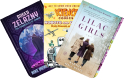
I read the entire Sun Eater series this year, and I loved it. This is epic space opera in every sense of the word.
The main character tells the story of his life as an old man. He tells you upfront that he committed a horrible atrocity and that he is despised throughout the universe. Most people think he is a monster; some think he is a hero.
The series slowly walks you through his life and what led him to this terrible event.The series is philosophical at times about morality and the decisions we make. I loved that perspective and enjoyed the slower, more introspective pacing between the action.
The world is vast, and I enjoyed getting lost within it. I read for character development, and this book doesn't disappoint. I was nervous to finish the last book and be forced to say goodbye to the cast.
Hadrian Marlowe, a man revered as a hero and despised as a murderer, chronicles his tale in the galaxy-spanning debut of the Sun Eater series, merging the best of space opera and epic fantasy.
It was not his war.
On the wrong planet, at the right time, for the best reasons, Hadrian Marlowe started down a path that could only end in fire. The galaxy remembers him as a hero: the man who burned every last alien Cielcin from the sky. They remember him as a monster: the devil who destroyed a sun, casually annihilating four billion human lives--even the…
The story is set in an alternate post-WWI Britain overrun by Fae. It is dark and violent, and if you are squeamish, you might want to avoid this one. It's like the Brothers Grimm, but like the original German texts before they got Disneyfied.
The main character is a scarred/broken soldier who now specializes in recovering children that the Fae take from mothers. The story expands from there.
If you like the Dresden Files or Rivers of London, I think you will dig this book. I am desperately hoping there will be a sequel.
A compelling standalone dark fantasy set in a gritty post-WWI Britain that has been overrun by the fae, from the award-winning author of Altered Carbon
“One of my favorite books of the year, destined to be a classic.”—Tim Lebbon, New York Times bestselling author of Secret Lives of The Dead
The Great War was supposed to be the war to end all wars—and maybe it would have been, had an even greater, otherworldly foe not risen to extinguish the conflict. Overnight, as guns blazed in France and Flanders, village after village in the quiet British countryside was swallowed by the…
I picked this as part of my multi-year deep dive into the rise of Fascism. This book stands out as one of the most riveting and thought-provoking so far. I was a history major in college, and I didn't realize how much we glossed over during this period.
This book makes you feel the slow change in Germany as Fascism became more and more acceptable. At first, the violence and insane rhetoric were ignored or written off, but as it grew, people became more desensitized. It felt like being in a bath that is slowly getting hotter. You only notice it is boiling when you are too late to change anything.
The way the Nazi Party convinced more and more of the voting bloc to support them was chilling. As an American, I had to put the book down a few times because the parallels with the rise of Trump were too close to home. As a kid, I thought educated voters thought about candidates, examined the reality of their policies, and voted. American schools don't really teach you the reality that this book shows you: how easily high inflation or propaganda during a crisis can convince a majority of voters to back a tyrant who promises to fix everything. And now, as inflation and costs spike, we are watching this once again.
Watching the Weimar Republic slowly get torn down was hard to read. This book further entrenched my view that if your democratic government doesn't deliver results for its citizens, voters who are in pain will replace it with tyranny even if they know better. Democracies have to deliver results. They can be slow, but they can't be so incompetent that everything is on fire.
Richard J. Evans' The Coming of the Third Reich: How the Nazis Destroyed Democracy and Seized Power in Germany explores how the First World War, the Weimar Republic and the Great Depression paved the way for Nazi rule.
They started as little more than a gang of extremists and thugs, yet in a few years the Nazis had turned Germany into a one-party state and led one of Europe's most advanced nations into moral, physical and cultural ruin and despair.
In this consummate and compelling history, the first book in his acclaimed trilogy on the rise and fall of Nazi…