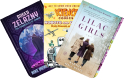
Good books about language - one’s own or a foreign tongue - are a real reading treat for me. In part, this is because there are never enough such books with just the right balance of erudition and entertainment, with miscellaneous tidbits and tales of local culture too.
La Bella Lingua has it all, and I was also fortunate to be able to spend two weeks in Rome this year, and read it in situ. A wonderful read that spurred my new found love of the Italian language.
A celebration of the language and culture of Italy, La Bella Lingua is the story of how a language shaped a nation, told against the backdrop of one woman’s personal quest to speak fluent Italian.
For anyone who has been to Italy, the fantasy of living the Italian life is powerfully seductive. But to truly become Italian, one must learn the language. This is how Dianne Hales began her journey. In La Bella Lingua, she brings the story of her decades-long experience with the “the world’s most loved and lovable language” together with explorations of Italy’ s history, literature, art,…
I honestly can’t say whether or not I’d previously read The Voyage of the Beagle, but coming to it (again?) this year it was incredibly fresh, a brilliant work of what come under the category of ‘travel’ or ’nature writing’, but this would be to severely limit all the things Darwin addresses.
In addition to his observations on natural history, which really are astonishing and a joy to read, he deals with a lot of issues around social justice, for instance writing about the terrible conditions of slaves he encounters in various parts of the world. I’m so pleased to have (re-)discovered this classic work.
Charles Darwin's travels around the world as an independent naturalist on HMS Beagle between 1831 and 1836 impressed upon him a sense of the natural world's beauty and sublimity which language could barely capture. Words, he said, were inadequate to convey to those who have not visited the inter-tropical regions, the sensation of delight which the mind experiences'.
Yet in a travel journal which takes the reader from the coasts and interiors of South America to South Sea Islands, Darwin's descriptive powers are constantly challenged, but never once overcome. In addition, The…
How does it go? So many books, so little time. I can’t believe I am only this year discovering the work of the brilliant Pat Barker. Her writing took me right back to some of the greatest novelists I’ve enjoyed over the years, for the quality of their work, not necessarily for the same themes or style of writing. Among these, I would include Dickens, Thomas Hardy, Evelyn Waugh, Graham Greene, and John le Carré.
I have made a commitment - from July 2024 to June 2025 - to read at least one novel a month by a woman author I have not previously read, and with Pat Barker I struck gold early on. The only problem is, now I feel I have to wait until moving on to the rest of the Regeneration trilogy, and everything else she’s written!
"Calls to mind such early moderns as Hemingway and Fitzgerald...Some of the most powerful antiwar literature in modern English fiction."-The Boston Globe
The first book of the Regeneration Trilogy-a Booker Prize nominee and one of Entertainment Weekly's 100 All-Time Greatest Novels.
In 1917 Siegfried Sasson, noted poet and decorated war hero, publicly refused to continue serving as a British officer in World War I. His reason: the war was a senseless slaughter. He was officially classified "mentally unsound" and sent to Craiglockhart War Hospital. There a brilliant psychiatrist, Dr. William Rivers, set about restoring Sassoon's "sanity" and sending him…
The Sahara is my attempt to produce as accessible a book about the world’s greatest desert as possible. After discussing the history of the desert itself, my work considers how it has inspired and influenced poets, authors, artists, filmmakers, explorers, and a few cranks, from the earliest examples of rock art to empires of Ancient Egypt, Greece, and Rome, and on through the Arab invasions, to the modern European incursions, from Napoleon to the Second World War and beyond.
The best books about Egypt and the Sahara before and during WWII all feature in The Sahara, and while each is great in its own right they also complement each other very nicely, from travel and exploration to memoir, two novels, one in English and one by the Arab world’s first winner of the Nobel Prize in Literature.
A wonderfully imaginative tale from a master story-teller, this one had slipped by us until this
year. As delightful as any of Morpurgo’s offerings, this book features a time-travelling ghost,
buried treasure, and a friendship that works across centuries.
Don’t let anyone ever put you off any book until you have tried it for yourself. Beowulf
might sound ‘too hard’ or ‘too old’ for children, but not a bit of it. Heaney breathes new life
into an old tale, making this a sparkling, dangerous, and compelling book. It’s no wonder he
won the Nobel Prize in Literature. The introduction may not be right for bedtime, but do read
it some other time.
Composed towards the end of the first millennium, the Anglo-Saxon poem Beowulf is one of the great Northern epics and a classic of European literature. In his new translation, Seamus Heaney has produced a work which is both true, line by line, to the original poem, and an expression, in its language and music, of something fundamental to his own creative gift.
The poem is about encountering the monstrous, defeating it, and then having to live on, physically and psychically exposed, in that exhausted aftermath. It is not hard to draw parallels between this story and the history of the…
There are countless ‘classics’ of children’s literature that, for one reason or another, over time
lose their lustre and fall short of one’s own childhood memories. The Phantom Tollbooth is as
wonderful today as when it was written, more than 60 years ago. Join Milo on a fantabulous
journey through place and a gallimaufry of crazy characters, word play, and puns.
With almost 5 million copies sold 60 years after its original publication, generations of readers have now journeyed with Milo to the Lands Beyond in this beloved classic. Enriched by Jules Feiffer’s splendid illustrations, the wit, wisdom, and wordplay of Norton Juster’s offbeat fantasy are as beguiling as ever.
“Comes up bright and new every time I read it . . . it will continue to charm and delight for a very long time yet. And teach us some wisdom, too.” --Phillip Pullman
For Milo, everything’s a bore. When a tollbooth mysteriously appears in his room, he drives through only…