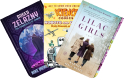
Although the book has the worst title imaginable, it tells the remarkable story of how the residents of Timbuktu who have been guardians of several custodial family libraries, containing the richest source of Arabic manuscripts from the 14th century and earlier, at a time when TImbuktu was the capital of the Kingdon of Mali, hid, outwitted and saved these precious manuscripts and books from the hands of Islamic fanatics connected with Isis, by secretly at night removing them to the saftey of the capital Bamako hundred of miles to the south. And how UNESCO and many other universities around the world helped Timbuktu create a modern library
In the 1980s, a young adventurer and collector for a government library, Abdel Kader Haidara, journeyed across the Sahara Desert and along the Niger River, tracking down and salvaging tens of thousands of ancient Islamic and secular manuscripts that were crumbling in the trunks of desert shepherds. His goal: to preserve this crucial part of the world's patrimony in a gorgeous library. But then Al Qaeda showed up at the door. Joshua Hammer writes about how Haidara, a mild-mannered archivist from the legendary city of Timbuktu, became one of the world's greatest smugglers by saving the texts from sure destruction.…
Franz Fanon is the greatest revolutionary intellectual of the mid 20th century. Fanon made confronting the historical realities of decolonization inescapable. He cast a light on the terrifying and terroristic underside of white supremacist European imperialism. In the words of Jean-Paul Sartre: "Read Fanon: You will see that in a time of helplessness, murderous rampage is the collective unconscious of the colonized.
First published in 1961, Frantz Fanon’s The Wretched of the Earth is a masterful and timeless interrogation of race, colonialism, psychological trauma, and revolutionary struggle. In 2020, it found a new readership in the wake of the Black Lives Matter protests and the centering of narratives interrogating race by Black writers. Bearing singular insight into the rage and frustration of colonized peoples, and the role of violence in spurring historical change, the book incisively attacks the twin perils of post-independence colonial politics: the disenfranchisement of the masses by the elites on the one hand, and intertribal and interfaith animosities on…
Frederick Douglass was one of the great 19th century American abolitionists, social reformers and orators. His life spanned from his enslavement, his escape, to his meetings with presidents. His is a lively story of things 21st century Americans can't imagine. It's eye opening because it's the actual words and feelings of a former slave.
Frederick Douglass (born Frederick Augustus Washington Bailey, cFebruary 1818– February 20, 1895) was an African-American social reformer, abolitionist, orator, writer, and statesman. After escaping from slavery in Maryland, he became a national leader of the abolitionist movement from Massachusetts and New York, gaining note for his dazzling oratoryand incisive antislavery writings. Life and Times of Frederick Douglass is Frederick Douglass' third autobiography, published in 1881, revised in 1892. Because of the emancipation of American slaves during and following the American Civil War, Douglass gave more details about his life as a slave and his escape from slavery in this volume…
A Mediterranean Feast: The Story of the Birth of the Celebrated Cuisines of the Mediterranean from the Merchants of Venice to the Barbary Corsairs, with More than 500 Recipes
Winner of the James Beard Cookbook of the Year in 2000 and the Beard award for the Best Writing about Food. A groundbreaking culinary work of extraordinary depth and scope that spans more than one thousand years of history, A Mediterranean Feast tells the sweeping story of the birth of the venerated and diverse cuisines of the Mediterranean. Author Clifford A. Wright weaves together historical and culinary strands from Moorish Spain to North Africa, from coastal France to the Balearic Islands, from Sicily and the kingdoms of Italy to Greece, the Balkan coast, Turkey, and the Near East.