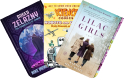
I was very familiar with Homer's The Odyssey, but this was a whole new take on it. It consists of short tales that are spinoffs or what-might-have-been variations. Clever, beautifully written, moving.
After ten years' journeying Odysseus returns, again and again, to Ithaca. Each time he finds something different: his patient wife Penelope has betrayed him and married; his arrival accelerates time and he watches his family age and die in front of him; he walks into an empty house in ruins; he returns but is so bored he sets sail again to repeat his voyage; he comes back to find Penelope is dead.
In these forty-four retellings of passages from Homer's Odyssey, Zachary Mason uses Homer's linear narrative and explodes it: presenting alternative and contradictory fragments of familiar stories - the…
I'm a big fan of Saramago, but he outdid himself with this one. After a rather slow start, it drew me in completely. By the end, I was crying. Saramago's style, which runs everything together, rather like Marquez, with no quotation marks for dialogue, takes some getting used to, but once you get in the groove, it's fascinating.
Nobel Prize-winner Jose Saramago's brilliant novel poses the question—what happens when the grim reaper decides there will be no more death? On the first day of the new year, no one dies. This of course causes consternation among politicians, religious leaders, morticians, and doctors. Among the general public, on the other hand, there is initially celebration—flags are hung out on balconies, people dance in the streets. They have achieved the great goal of humanity: eternal life. Then reality hits home—families are left to care for the permanently dying, life-insurance policies become meaningless, and funeral parlors are reduced to arranging burials…
I had never heard of the book or the author before; turns out it was first published back in 1944, and was widely banned because of its depiction of an interracial romance. It's infuriating to read because of the injustice, but so moving you can't look away.
When it was first published in 1944, this novel sparked immediate controversy and became a huge bestseller. It captured with devastating accuracy the deep-seated racial conflicts of a tightly knit southern town. The book is as engrossing and incendiary now as the day it was written.
"A satisfying thriller with enough history and mysteries to keep readers enthralled until the end." -Kirkus Reviews
As the conflict in Vietnam heats up, Simon Hannay is pursuing his Masters in Comparative Literature at a Midwest university, teaching karate on the side and doing his best to avoid the draft. He's not overly excited about his thesis... until he stumbles upon an encrypted Renaissance journal that's been hidden for decades in the rare book room.
Simon, who's been fascinated by codes and ciphers since he was a kid, convinces his advisor to let him use the mysterious codex as his thesis topic. But first he has to decipher it—and, as he soon learns, that's going to be a formidable task. To add to his problems, an unidentified rival he calls the Mystery Man is desperate to get his hands on the codex—so desperate that he ransacks Simon's apartment and even drugs and interrogates him and his advisor.
With the help of Gabriela, a Brazilian classmate, Simon finally hits upon the key to the cipher. Together they struggle to unravel and translate the text, which was penned by a 16th-century Portuguese fortune-hunter. In the process, they learn the secrets the codex contains, and why the Mystery Man is so determined to steal it.