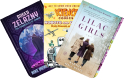
NATIONAL BOOK AWARD WINNER * NEW YORK TIMES BESTSELLER * WINNER OF THE CUNDILL HISTORY PRIZE
'A remarkable book' - Jennifer Szalai, The New York Times 'A brilliant exercise in historical excavation and recovery' - Annette Gordon-Reed, author of The Hemingses of Monticello 'A history told with brilliance and tenderness and fearlessness' - Jill Lepore, author of These Truths: A History of the United States
In 1850s South Carolina, Rose, an enslaved woman, faced a crisis: the imminent sale of her daughter Ashley. Thinking quickly, she packed a cotton bag with a few items. Soon after, the nine-year-old girl was…
Twists & turns that take a familiar 2026 premise and turn it upside-down, taking us with its unsympathetic but fascinating narrator on a journey that changes every part of our perspective.
'My name is Natalie Heller Mills, and I was perfect at being alive...'
Natalie lives a traditional lifestyle - and her followers are sick with envy. Her charming farmhouse on her working ranch is artfully cluttered, her husband is a handsome cowboy, her homemade sourdough boules are each more beautiful than the…
LONGLISTED FOR THE 2026 NATIONAL BOOK AWARD FOR FICTION
“This masterpiece is the novel of the decade, if not the century... The Disappearers places [James] near the front of the line, a decade or two from now, for the Nobel Prize.” –The New York Times
“Harrowing, hilarious, magnificent …this novel will be read decades from now, pored over in seminars and bookmarked on subway commutes … [James’] defiant queer epic belongs to us all.” –The Boston Globe
“Among Marlon James’s most ambitious and history-making works… James is a…
"We the People." The Constitution begins with those deceptively simple words, but how do Americans define that "We"? In We the People, Ben Railton argues that throughout our history two competing yet interconnected concepts have battled to define our national identity and community: exclusionary and inclusive visions of who gets to be an American.
From the earliest moments of European contact with indigenous peoples, through the Revolutionary period's debates on African American slavery, 19th century conflicts over Indian Removal, Mexican landowners, and Chinese immigrants, 20th century controversies around Filipino Americans and Japanese internment, and 21st century fears of Muslim Americans, time and again this defining battle has shaped our society and culture.
Carefully exploring and critically examining those histories, and the key stories and figures they feature, is vital to understanding America—and to making sense of the Trump era, when the battle over who is an American can be found in every significant debate and moment.