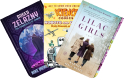
The latest sci-fi to gain momentum, one of these books was tossed in my lap by a close friend, and I found it delightful—The Murderbot Diaries, by Martha Wells.
It recounts the tale of a group of people on a planetary survey suddenly coming under threat of death, not from dangerous fauna, though the novella begins with such an attack, but from their own security “bots” known as “SecUnits” in the lingo of this world.
The interesting thing about this story is that it is told entirely from the Point of View of a SecUnit among the other Human characters, and that viewpoint is almost comical at times. Calling himself a “Murderbot,” we don’t get to the root of that part of the story until much later, or even know the reason there is a threat to this SecUnit’s Human “clients.”
All that is background to the foreground stream of consciousness of this robot, which is obsessed with his entertainment “media” and is constantly commenting inwardly about the foibles and habits of the Humans he serves.
All Systems Red by Martha Wells begins The Murderbot Diaries, a new science fiction action and adventure series that tackles questions of the ethics of sentient robotics. It appeals to fans of Westworld, Ex Machina, Ann Leckie's Imperial Raadch series, or lain M. Banks' Culture novels. The main character is a deadly security droid that has bucked its restrictive programming and is balanced between contemplative self discovery and an idle instinct to kill all humans. In a corporate dominated s pa cef a ring future, planetary missions must be approved and supplied by the Company. Exploratory teams are accompanied by…
This is an odd alternate history, but one that sneaks up on you very quietly. It begins with a writer researching the lives of two identical twins in England at the outset of WWII.
They had been Olympic rowers together earlier, but in spite of their brotherly love, they took two very distinct life paths in the war. One becomes a pacifist, and so he joins the Red Cross, while the other joins the RAF and becomes a bomber pilot in the war effort.
Then, as you read, there comes a subtle ripple of something amiss in the events of the war. Being very familiar with the chronology of WWII, and to great detail, I immediately caught these aberrant things that I knew simply did not happen the way the author was describing them, and that was when I realized that this was an alternate history of those events.
THE SEPARATION is the story of twin brothers, rowers in the 1936 Olympics (where they met Hess, Hitler's deputy); one joins the RAF, and captains a Wellington; he is shot down after a bombing raid on Hamburg and becomes Churchill's aide-de-camp; his twin brother, a pacifist, works with the Red Cross, rescuing bombing victims in London. But this is not a straightforward story of the Second World War: this is an alternate history: the two brothers - both called J.L. Sawyer - live their lives in alternate versions of reality. In one, the Second World War ends as we imagine…
This was a book I read decades ago as a younger man, and I thought I might revisit it,
The story relates what befell Elwin Ransom while on a walking tour, who finds himself drugged and pulled onto a makeshift spacecraft that takes off for a voyage to a nearby planet, where he meets the local native species and becomes part of a trek to meet the supposed ruler of this world.
The book’s title is something he learned from the aliens, who say that the world he came from, Earth, is known to them as “the silent planet.” After these harrowing adventures, Ransom finally is able to get back to the spacecraft and make the return journey to Earth, jus before they run out of Oxygen.
The story is also overlaid with the theocracy of C.S. Lewis and his conception of good vs evil. In reading it a second time, my older, more discriminating mind was not as receptive to it as I was when younger. Yet I still found it an enjoyable fantasy, and would go on to read the rest of the C.S. Lewis Space Trilogy, which included Perelandra and That Hideous Strength.
The first novel in C.S. Lewis's classic sci-fi trilogy which tells the adventure of Dr Ransom who is kidnapped and transported to Mars
In the first novel of C.S. Lewis's classic science fiction trilogy, Dr Ransom, a Cambridge academic, is abducted and taken on a spaceship to the red planet of Malacandra, which he knows as Mars. His captors are plotting to plunder the planet's treasures and plan to offer Ransom as a sacrifice to the creatures who live there. Ransom discovers he has come from the 'silent planet' - Earth - whose tragic story is known throughout the…
A classic Space opera this is the story of a Special Services investigator sent out to a new colony prospect that has not been responding to communications. Arriving and landing on the Safe Zone harboring a Life Form Conservatory and a military outpost, Lieutenant Ryan finds both facilities destroyed. The story is his effort to determined what happened here, which becomes a journey through astrobiology, Artificial Intelligence, and an insidious virus at war with a hidden entity on this planet. The story spawn two sequels to complete a trilogy, Mother Heart and Nightwatch, and has everything from harrowing forays into the “Wild Zone,'” which is everything on the planet outside the steril Safe Zone. It also sees duels in space when a corrupt senior civilian official takes an interest in this situation and decides to clean it up with missiles. Ryan must get back into space and fend off the hostile attentions of a “Black Ship” a cruiser from his own SS Division out doing the bidding of this corrupt civilian.
The tale had a panoply of alien life in the Wild Zone, Robots, space duels, and a planetary crisis when a species first categorized as harmless suddenly turns out to be an apex predator.