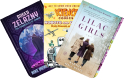
An emotional children’s story that reminded me of ‘The Boy in the Striped Pyjamas’, but in this case it a young boy is inside the fence of a refugee camp and a young girl is on the other side of the fence. His story is told in his own words, which adds to the substance of the book and its value as a statement of our time, which makes it even more poignant.
That people, including children, are still being held in these terrible situations needs to be talked about and this book is an excellent way of understanding more about the plight of so many displaced people today. I enjoyed the characters and the way that they interact with one another in such an honest and open way.
Winner of the CILIP Amnesty Honour 2017. Shortlisted for the Guardian Children's Fiction Prize and the CILIP Carnegie Medal 2017.
Perfect for fans of THE BOY IN THE STRIPED PYJAMAS. This is a beautiful, vivid and deeply moving story about a refugee boy who has spent his entire life living in a detention centre. This novel reminds us all of the importance of freedom, hope, and the power of a story to speak for anyone who's ever struggled to find a safe home.
'...a special book' - Morris Gleitzman, author of the acclaimed ONCE series
The book is set in the near future in a time where consideration is being given to the re-definition of fundamentalism as a mental illness. I found it interesting to read the views and beliefs of the two main characters, April and the criminal psychologist Finley Logan, and how their relationship with one another and with their faith ‘devotion’ was developed.
The book had me thinking about and trying to understand the reasons why the character April, a 19-year old elective mute, detonated a bomb on a university bus and killed 15 students of a similar age. Logan’s role is to decide April’s sanity and therefore also her responsibility for the atrocity.
When Finley meets with Gabrielle who conducts research into spiritual and mystical experiences, the discussions become more thought provoking. A brilliant read, which, will have you thinking about the relationship between devotion, science and spirituality
April is angry.Only nineteen, she is an elective mute, accused of a religiously motivated atrocity. Dr Finlay Logan is broken. A borderline-suicidal psychologist still reeling from his daughter's death, he must assess April's sanity in a world where - ten years after the death of Richard Dawkins - moves have been made to classify religious belief as a form of mental illness. Both April and Finlay struggle to understand what has happened to them, sharing secrets, silence and an inability to deal with the world around them.
Gently unpicking the lives of these two broken characters, Barber offers a…
I have enjoyed Victoria’s books and was particularly interested by her stories of the Greek island of Spinalonga and its lepers’ colony. This is her story of Spinalonga written for children. Using English and Greek, Rita’s grandmother tells her about the photo that she has seen in her grandmother’s house during holiday visits to the Crete village of Plaka.
I enjoyed hearing with Rita about her mother, Maria, and the role she played in the history of Spinalonga. The story covers the shame and stigma of leprosy with compassion. I was interested to read about how a cure for leprosy and about the closure of the island. A fabulous little book and definitely worth reading to the end to find out the special significance of the painted pebble with the Greek words kathe mera tha se skefto, which mean ‘every day I will think of you’.
A dramatic and moving story set in the same world as the international bestseller The Island from the celebrated novelist Victoria Hislop. The absorbing story of the Cretan village of Plaka and the tiny, deserted island of Spinalonga - Greece's former leper colony - is told to us by Maria Petrakis, one of the children in the original version of The Island. She tells us of the ancient and misunderstood disease of leprosy, exploring the themes of stigma, shame and the treatment of those who are different, which are as relevant for children as adults. Gill Smith's rich, full-colour illustrations…
From small beach pebbles to huge megaliths, stones have been revered, collected, enhanced, sculpted or engraved for practical and artistic purposes throughout the ages. They have been used to delineate boundaries and to build homes and shelters, and utilized for cooking, games and competitions. This surprising and fascinating compendium of stone facts, myths and stories reveals the impact and importance of stones in our history and culture.
Cally Oldershaw introduces the science in an accessible way and covers the aesthetic appeal of stones, their practical uses and metaphysical properties. With an eclectic mix of examples from the Stone Age to the present, Stones engagingly excavates the story of this essential matter.