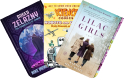
I loved the authentic setting in London in the mid-1970s, which was real in every way to me. The insights Judd offers from experience into the shadowy world of British intelligence are comparable to Le Carré's, with the same knowing detachment as the plot rolls along. The story is all too believable while maintaining its high-stakes premise, and grips until the final page. The hero Charles Thoroughgood manages to be both relatable and an action-man risk-taker when required. Can't believe it took me so long to discover this novel.
Charles Thorougood is an agent of MI6 working in London during the Cold War, with a young Soviet assistant. Unexpectedly he learns of a strange legacy left to him by his estranged father, the implications of which are much darker than expected at first. The first novel in a spy trilogy.
I bought this novel without knowing anything about it, simply because I love books set in Cambridge. It's 1994 and Professor Don Lamb is an art historian at a fictional college I envisaged as Peterhouse, researching the painted skies of the Venetian master Tiepolo. From the first page the quality of the writing drew me in to this strange tale which sees poor Lamb slaughtered at every turn. Brilliant academic he may be, but he is woefully lacking in life experience or the ability to read others' motives. He is a misguided as much as an unreliable narrator. His new life in London, into the 1990s art and gay scene there is infused not only by wonder and liberation, but a sense of fear for him on the part of the reader. By turns hilarious and sad as the truth of his own past is revealed.
'The best novel I have read for ages. My heart was constantly in my throat as I read . . . There is so much to enjoy, to contemplate, to wonder at, and to be lost in' Stephen Fry
'Meticulous and atmospheric . . . delicious unease and pervasive threat give this assured first novel great singularity and a kind of gothic edge' Michael Donkor, Guardian
Cambridge, 1994. Professor Don Lamb is a revered art historian at the height of his powers, consumed by the book he is writing about the skies of the Venetian master Tiepolo. However, his academic…
I have become a bit obsessed with Cold War history and fiction, but had never heard much about Michal Goleniewski. Though some say he was one of the best spies the West ever had, he remains one of the least known figures of this fascinating era, largely written out of the history books. Tim Tate does a brilliant job of uncovering why that should be, drawing on previously-unpublished primary source documents. Though Goleniewski exposed hundreds of KGB agents operating undercover in the West, including George Blake and the 'Portland Spy Ring', the problem was, he was a deeply flawed man - greedy for Western funds, and to the generous CIA's embarrassment, a bigamist and fantasist who ended his career claiming publicly to be the last descendent of the Russian Tzar and heir to the Romanov fortune. It's a wild ride of an espionage tale.
Spring 1958: a mysterious individual believed to be high up in the Polish secret service began passing Soviet secrets to the West.
His name was Michal Goleniewski and he remains one of the most important, least known and most misunderstood spies of the Cold War. Even his death is shrouded in mystery and he has been written out of the history of Cold War espionage - until now.
Tim Tate draws on a wealth of previously-unpublished primary source documents to tell the dramatic true story of the best spy the west ever lost and how Goleniewski exposed hundreds of KGB…
Moscow, 1958. At the height of the Cold War, secretary Lois Vale is on a deep-cover MI6 mission to identify a diplomatic traitor. She can trust only one man: Johann, a German journalist also working covertly for the British secret service. As the trail leads to Vienna and the Black Sea, Lois and Johann begin an affair but as love grows, so does the danger to Lois.
A tense Cold War spy story told from the perspective of a bright, young, working-class woman recruited to MI6 and based on the diaries of the author's late mother, who worked for British intelligence in Moscow.
Deborah Lawrenson is the author of The Lantern, The Sea Garden, and 300 Days of Sun.