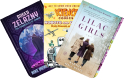
The best books of 2024

This list is part of the best books of 2024.

Join 2,415 readers and share your 3 favorite reads of the year.

My favorite read in 2024

Book cover of Precipice

Christopher Steed ❤️ loved this book because...

Summer 1914. A world on the precipice of cataclysmic war.

Twenty-six-year-old Venetia Stanley—aristocratic, clever, bored, reckless—is part of a group of upper-crust bohemians and socialites known as “The Coterie.” Her secret is that she is engaged in a clandestine love affair with the Prime Minister, H. H. Asquith, a man more than twice her age. He writes to her obsessively, sharing the most sensitive matters of state. Often, he writes in the midst of Cabinet discussions of the most momentous and serious kind. His country is about to go to war and Asquith is writing assiduously to Venetia. What is in his mind?
Or is it secret? Her parents seem to know about it. And so do others….

As Asquith reluctantly leads the country into war with Germany, a young intelligence officer with Scotland Yard is assigned to investigate a leak of top-secret documents. Suddenly, what was a sexual intrigue becomes a matter of national security that could topple the British government—and will alter the course of political history.
Harris weaves a compelling narrative in which the intelligence officer, on loan from the Metropolitan Police, follows the clues and begins to uncover that the leak of documents beyond top-secret have been casually thrown from a car window- a car belonging to a certain H H Asquith. The trail takes him to Angelsey where the Stanleys have a country residence. The policeman's work implicates him emotionally in the affair and its deterioration to the point where it becomes a sort of menage a trois.

We then see the developing relationship with a colleague of Asquith and Venetia's eventual marriage to him.

The momentous days leading up to and following the declaration of war provide the backcloth for a drama that is political thriller and grand police work. Seamlessly weaving fact and fiction, Precipice is a highly recommended electrifying thriller from Robert Harris.

  • Loved Most

    🥇 Character(s) 🥈 Outlook
  • Writing style

    ❤️ Loved it
  • Pace

    🐇 I couldn't put it down

By Robert Harris ,

Why should I read it?

4 authors picked Precipice as one of their favorite books, and they share why you should read it.

What is this book about?

“Robert Harris is, simply put, masterful.”—Karin Slaughter

A spellbinding novel of passion, intrigue, and betrayal set in England in the months leading to the Great War from the bestselling author of Act of Oblivion, Fatherland, The Ghostwriter, and Munich.

Summer 1914. A world on the brink of catastrophe.

In London, twenty-six-year-old Venetia Stanley—aristocratic, clever, bored, reckless—is part of a fast group of upper-crust bohemians and socialites known as “The Coterie.” She’s also engaged in a clandestine love affair with the Prime Minister, H. H. Asquith, a man more than twice her age. He writes to her obsessively, sharing the most…


When you buy books, we may earn a commission that helps keep our lights on (or join the rebellion as a member).

My 2nd favorite read in 2024

Book cover of Defeat Into Victory: Battling Japan in Burma and India, 1942-1945

Christopher Steed ❤️ loved this book because...

“From Defeat into Victory” William Slim
My third read is being enjoyed for the 2nd outing but this time I am reading it in Myanmar, Burma as it was known in 1989.
Slim’s 550-page epic details his experiences leading British and Indian troops in Burma from 1942–1945. Whereas many memoirs by generals focus on themselves, Slim details the campaign overall in minute detail, rarely compliments himself, and lavishes praise on his troops. It is an incredible look into a complete military campaign from the most outstanding soldier Britain produced during the 2nd World War.
Slim generated awesome loyalty amongst his soldiers. I have met some of the ‘forgotten’ 14th Army in my time as Vicar and honorary padre.
Things start out in 1942 with “The Retreat” as the British are routed from Rangoon and Burma, all the way back into India. Burma Corps arrives back in India in shambles — men barely alive, carrying only their personal weapons, having force-marched out of some of the most hostile terrain on the planet as the Monsoons began to descend on the region. Morale and fighting spirit was nil as the Japanese forces embraced the jungle and moved fluidly through it, whereas the British-led troops were road-bound. Quickly, Slim understood these factors.
Finally once able to regroup, Slim rebuilt his army. Not only in organization, but also in tactics and techniques. They trained for jungle warfare and became as swift in navigating it as the Japanese. They learned how to patrol and no longer fear being isolated. The travelled light and kept the engineering formations close to the front — building roads right behind the battle-lines to keep supplies flowing.
His divisions were converted to 2 mechanized and 1 air-transportable brigade. The air-mobile brigades had their heavy equipment modified to fit into C-47’s. His use of air mobility was inspired. When an airfield was captured, an air-landing brigade was flown in to take over the sector while the mechanized formations advanced on. At one point he used glider troops to seize open parts of the jungle, and then carve out airstrips there to fly in full brigades and even support fighter operations.
His use of timing, deception, tempo, and the mechanics of warfare are excellent. On top of which, he understood and describes the essence of leadership in the field. His division and brigade commanders were left to run their units without interference — and they got results. Troops were always in-the-know about the big picture — everyone felt involved — everyone felt important. Slim was intellectually nimble but also an inspired leader.
Slim understood his enemy at all levels. He understood the tenacity of the Japanese soldier in defence, their bravery on offense, and their savage treatment of prisoners and occupied populations. He grasped that the Japanese would plan with an assumption of capturing supplies, and responded poorly when plans went wrong. For instance, to meet an unexpected bridge-head over a river they’d throw formations at it piecemeal instead of waiting to mass for an attack. Slim used the Japanese’s boldness against them — if he just delayed them and denied them capture of key supply dumps, supplies would run out and they could be attacked.
Given the relatively small number of troops and limited supplies allotted to his forces, what Slim accomplished was amazing. Using innovative ways to bring troops and supplies to the front and reshaping an army trained for warfare in Europe or North Africa to fight in dense jungles. He used mechanized, air-landing, Para troops, Gurkhas, marines, long-range patrols, tanks, and militias behind the lines. When they ran out of silk parachutes to air-drop supplies, he had more constructed out of jute fibres. They built their own personal navy and landing ships out of local resources if the Royal Navy had none to spare: their resourcefulness as remarkable as tactics.
Slim demanded that surrendering officers to also surrender their swords, and do so in front of their troops. Even though MacArthur issued orders forbidding this, Slim insisted. He felt it was important for the Japanese troops to realize that they had been defeated.
Slim’s war memoir, “Defeat Into Victory,” has become a staple in military reading lists.

  • Loved Most

    🥇 Teach 🥈 Writing
  • Writing style

    ❤️ Loved it
  • Pace

    🐕 Good, steady pace

By Field-Marshal Slim ,

Why should I read it?

2 authors picked Defeat Into Victory as one of their favorite books, and they share why you should read it.

What is this book about?

Field Marshal Viscount Slim (1891-1970) led shattered British forces from Burma to India in one of the lesser-known but more nightmarish retreats of World War II. He then restored his army's fighting capabilities and morale with virtually no support from home and counterattacked. His army's slaughter of Japanese troops ultimately liberated India and Burma. The first edition of Defeat Into Victory , published in 1956, was an immediate sensation selling 20,000 copies within a few days. This is an updated version with a new introduction by David W. Hogan Jr.


My 3rd favorite read in 2024

Book cover of The Collected Works of Sigmund Freud

Christopher Steed 👍 liked this book because...

The Revised Standard Edition of the Complete Psychological Works of Sigmund Freud, edited by Mark Solms,
There is an unconscious element of the mind
Before Freud, the idea of an unconscious mind was an oxymoron. Mental and conscious used to mean the same thing, so the idea that there are mental forces you can be unaware of was totally new.
Freud’s own model of consciousness – the id, ego and superego, which represent different parts of our minds, including animal drives as well as our personalities and moral compasses – hasn’t been proven by scientists.
But numerous scientific studies have since proved the role of the unconscious in a number of different brain processes – from determining how happy we are, to decision-making and forming memories.
Most of the mental processes that govern what we do, we’re not aware of them, and that’s knowledge we had in the first place because of Freud.
Babies have difficult lives, and early childhood is important
One of Freud’s most famous – and controversial – ideas is the Oedipus complex, where every male child “wants to have sex with his mother and murder his father.
What is not so far-fetched is “the fundamental phenomenon that Freud was theorising, that young children have very strong animal urges and attach to their caregivers to the point of being addicted to them”.
Those early childhood events are so formative, but happen so early in our lives that we don’t remember them.
The idea that events that happened when we were too young to remember can shape our whole lives is now well established.
Children who experience two stressful events before the age of two are more prone to psychological and social problems by the age of three, one study found, and such experiences can even cause an increased likelihood of developing type 2 diabetes in adulthood.
These sorts of heartfelt emotional struggles and conflicts of early childhood are real. Those are the phenomena that Freud called the Oedipus complex.”
Freud’s theory that events that happened when we were too young to remember can shape our whole lives is now well-established.

  • Loved Most

    🥇 Teach 🥈 Thoughts
  • Writing style

    👍 Liked it
  • Pace

    🐌 It was slow at times

By Sigmund Freud ,

Why should I read it?

1 author picked The Collected Works of Sigmund Freud as one of their favorite books, and they share why you should read it.

What is this book about?

This work has been selected by scholars as being culturally important, and is part of the knowledge base of civilization as we know it.

This work is in the "public domain in the United States of America, and possibly other nations. Within the United States, you may freely copy and distribute this work, as no entity (individual or corporate) has a copyright on the body of the work.

Scholars believe, and we concur, that this work is important enough to be preserved, reproduced, and made generally available to the public. We appreciate your support of the preservation process, and thank…


Don‘t forget about my book 😀

The Observer and the Observed: Valuable Personhood and a Theory of Everything

By Christopher Steed ,

Book cover of The Observer and the Observed: Valuable Personhood and a Theory of Everything

What is my book about?

This is a new argument for the existence of God based on
personhood from Chris Steed:
The Observer and the Observed: Valuable Personhood and a Theory of Everything
This book approaches the God-question in a different way than normal: from the perspective of psychotherapy. In a
world of machine intelligence, the key idea is an analogy of being between human personhood and divine
personhood as the only satisfactory way of showing that our inner conscious
awareness (nourished by the validation of the self) is responded to in ultimate
terms. It aims to extrapolate “from below,” from our psychological experience
to asking ultimate questions, drawing lines between:
• Observation in quantum physics
• The maternal gaze
• Recognition in social worlds that confer perception in place of invisibility
• The power of inter-subjectivity in relational neurobiology and therapy
What has to be accounted for is our sense of personhood and how that fits in
with a cosmos that is at best neutral. The metaphor of a “wifi” universe is
proposed but rather than a soulless device being switched on, how a human
psyche comes to a sense of consciousness of its own value is the issue here.
A personal God is the best explanation for the evidence of how our
personhood and subject status requires correspondence. As engaging with a
neutral AI entity is bound to be “soulless,” the first-person perspective requires an I-thou relationship.
A universe constructed from “nature” by itself or one where the ultimate is impersonal energy just does not cut it or
respond adequately to what is inside us. This book offers an account of how the realm
described by physics and our inner world can tie up—perhaps the only way they can

Book cover of Precipice
Book cover of Defeat Into Victory: Battling Japan in Burma and India, 1942-1945
Book cover of The Collected Works of Sigmund Freud

Share your top 3 reads of 2025!

And get a beautiful page showing off your 3 favorite reads.

1,210

readers submitted
so far, will you?