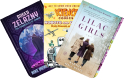
Syngman Rhee and the Moonies make cameos in this wide-ranging novel of Korea and Korean-Americans. But how do Leon Czolgasz, McKinley assassin; Harold Lloyd, silent movie star; and Parker Jotter fictional science-fiction author fit in? This highly original novel weaves together three narrative strands, moving back-and-forth across time and space. I read it in February and felt it might well be my favorite book of the entire year. I believe it was.
PULITZER PRIZE FINALIST • A wild, sweeping novel that imagines an alternate secret history of Korea and the traces it leaves on the present—loaded with assassins and mad poets, RPGs and slasher films, pop bands and the perils of social media
“Your view of twentieth-century history will be enlarged and altered. . . . A Gravity’s Rainbow for another war, an unfinished war.” —Jonathan Lethem, author of The Fortress of Solitude
WINNER OF THE LOS ANGELES TIMES BOOK PRIZE • ONE OF PUBLISHERS WEEKLY’S TEN BEST BOOKS OF THE YEAR • NEW YORK TIMES BOOK REVIEW EDITORS’ CHOICE
I have read every book Amor Towles has published, and this one may well be my favorite. Towles's originality and quirkiness are on full display in this diverse collection of stories: by turns comic and provocative, warm-hearted and disturbing. The last story, "Eve in Hollywood," is a novella whose interwoven plot showcases Towles's narrative virtuosity.
“A knockout collection. ... Sharp-edged satire deceptively wrapped like a box of Neuhaus chocolates, Table for Two is a winner.” —The New York Times
“Superb ... This may be Towles’ best book yet. Each tale is as satisfying as a master chef’s main course, filled with drama, wit, erudition and, most of all, heart.” —Los Angeles Times
Millions of Amor Towles fans are in for a treat as he shares some of his shorter fiction: six stories based in New York City and a novella set in Golden Age Hollywood.
"The Emperor of All Maladies" is science history at its best. A trained oncologist, Mukherjee has the experience needed to make abstruse concepts intelligible to lay readers (though the sheer volume will likely keep you challenged). The disease was terrifying enough to read about, but the early treatments--above all, the radical mastectomy--were shudder-inducing; the hubris of the early physicians and surgeons, galling. But there is much more to the story continues into and through the 20th century. Mukherjee's "biography" of the dread disease helps us understand our present by fearlessly exploring the broad sweep of cancer's past.
In The Emperor of All Maladies, Siddhartha Mukherjee, doctor, researcher and award-winning science writer, examines cancer with a cellular biologist's precision, a historian's perspective, and a biographer's passion. The result is an astonishingly lucid and eloquent chronicle of a disease humans have lived with - and perished from - for more than five thousand years.
The story of cancer is a story of human ingenuity,…