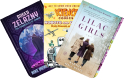
For me, food is a gateway to this moment, to radical
gratitude (I can trace one piece of food to all those who touched and grew it,
the elements of the earth that ripened it), and above all, connection. Growing
up in a South Asian immigrant home that felt like it was displaced in the deep
American south, we held on to food the way you hold on for safety. It connected
us back to our ancestors and our stories.
In this
memoir, Padma Lakshmi shows us how food was not only her anchor but also her path to
forging a life of meaning and, ultimately, unthinkable success.
Her retracing of
this geography reveals so much of her biography that it will leave you wondering
how your favorite childhood dish may just be the link to learning more about
who you are.
A vivid memoir of food and family, survival and triumph, Love, Loss, and What We Ate traces the arc of Padma Lakshmi's unlikely path from an immigrant childhood to a complicated life in front of the camera-a tantalizing blend of Ruth Reichl's Tender at the Bone and Nora Ephron's Heartburn Long before Padma Lakshmi ever stepped onto a television set, she learned that how we eat is an extension of how we love, how we comfort, how we forge a sense of home-and how we taste the world as we navigate our way through it. Shuttling between continents as a…
This book is like a Da Vinci code
for the modern-day question of how humans seek spiritual enlightenment.
As a
physician who practices and researches psychedelic medicine, this book is
essential reading for anyone who wants to understand how the modern resurgence
of psychedelics is actually an age-old quest. But even much more, it invokes
the questions of which roles might have been suppressed in the quest for power,
particularly those of women.
I learned so much and was left wanting to
understand more.
The world's biggest religion has a problem. There is zero archaeological evidence for the original Eucharist - the sacred wine said to guarantee life after death for those who drink the blood of Jesus. The Holy Grail and and its miraculous contents have never been found. In the absence of any hard data, whatever happened at the Last Supper remains a mystery for today's 2.5 billion faithful. The Immortality Key attempts to crack the best-kept secret in history by examining the archaic roots of the ritual that is performed every Sunday for nearly one third of the planet. Two thousand…
This collection of essays feels so intimate
in the author’s heart yet universal in all of ours. It’s a collection of
essays that explore connection and meaning in our lives as a path to Joy.
It’s
exactly why I describe Joy as so different than happiness. Each exploration the
author offers shows how Joy can spring from whatever is happening in our life,
not from a cognitive evaluation of how it is going. He speaks of how Joy
springs from our pain and sorrow, which I deeply believe.
They live so close to
each other, and each essay invites us to recognize this.
A collection of gorgeously written and timely pieces in which prize-winning poet and author Ross Gay considers the joy we incite when we care for each other, especially during life's inevitable hardships.
In "We Kin" he thinks about the garden (especially around August, when the zucchini and tomatoes come on) as a laboratory of mutual aid; in "Share Your Bucket" he explores skate-boarding's reclamation of public space; he considers the costs of masculinity in "Grief Suite"; and in "Through My Tears I Saw," he recognizes what was healed in caring for his father as he was dying.
If you think finding
Joy is too much to hope for or only for people who are “resilient enough,” Joy
Is My Justiceis a radical
exploration of your healing and liberation. Joy is not a commodity, a destination, or contrived positivity. It is within
you, the deepest justice you will ever know.
You can reclaim Joy despite this
unjust world, past traumas, or what a whitewashed wellness world says about
your capacity to do so.
Joy is your birthright. And It’s this book’s mission
to make sure you find yours.