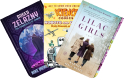
I love a good history book, and I love
well-written books. How to Hide an Empire is a fun and
informative history of all the territories the United States has controlled
over the years: how we got ‘em, and how we integrated them or gave them up.
Much of this was new and surprising to me. I liked the story of the U.S. Guano islands in the days when bird poop
was a highly valued commodity for fertilizer. The history of why the United States gave up its colonies right after
WWII was very insightful: a function of plastics, military bases, and
industrial standardization. He connects
Osama bin Laden, the Beatles, and Sony’s founder Akio Morita as direct
consequences of the system.
Named one of the ten best books of the year by the Chicago Tribune A Publishers Weekly best book of 2019 | A 2019 NPR Staff Pick
A pathbreaking history of the United States’ overseas possessions and the true meaning of its empire
We are familiar with maps that outline all fifty states. And we are also familiar with the idea that the United States is an “empire,” exercising power around the world. But what about the actual territories―the islands, atolls, and archipelagos―this country has governed and inhabited?
In How to Hide an Empire, Daniel Immerwahr tells the fascinating story…
Some
books you love because of where you were when you read them. During my recent sabbatical in Vienna, I was
determined to read a book by Stephan Zweig, perhaps the most popular writer in
the world during the 1920s, yet one whose works had fallen into relative
obscurity over time. A big reason is
that he was a Jewish writer in German just before the Nazis purged bookstores
and libraries of all such “degenerate” works.
This
book is a memoir of life buffeted by the events of the 20th century.
Zweig lived a rich intellectual life in the stability of Vienna toward the end of the Hapsburg empire in Austria. He watched that life shatter during WWI and the coming of the Nazis before fleeing into exile, ultimately in
South America. This is a book
documenting the collapse of civilization, written in the darkest days of the Second World War.
And
man, this guy could write! Even in
translation, you hear his voice: sensible, refined, warm, and funny. I learned
so much about the times and places of his life and found him fascinating.
The
story of this book is ultimately a tragedy. The day after he put the manuscript
in the mail to his publisher, he and his wife killed themselves, unwilling to
live longer in those days of darkness. But he left us the book about the world
of yesterday, a world well worth knowing and recalling.
The World of Yesterday, mailed to his publisher a few days before Stefan Zweig took his life in 1942, has become a classic of the memoir genre. Originally titled “Three Lives,” the memoir describes Vienna of the late Austro-Hungarian Empire, the world between the two world wars and the Hitler years.
Translated from the German by Benjamin W. Huebsch and Helmut Ripperger; with an introduction by Harry Zohn, 34 illustrations, a chronology of Stefan Zweig’s life and a new bibliography, by Randolph Klawiter, of works by and about Stefan Zweig in English.
Knuth is perhaps the true founder of
Computer Science, who set out in the late 1960s to produce a seven-volume
series of books containing all the foundations of the discipline.
Three volumes appeared by 1973, after which he
got distracted by many other things, and the promised volumes seemed destined never to emerge. But Knuth finished Volume 4A in
2011, after a lapse of 35 years. And then, in the Fall of 2022, at the age of 84, he
published the 712-page Volume 4B: Combinatorial Algorithms Part II!
There is nothing in the world like
a Knuth book. He has a unique way of looking at the world and an unrivaled sense
of detail and humor. He goes deeper down
rabbit holes than any man alive, and you come out smarter and with a sense of
wonder that such books really exist.
Volume 4B is dedicated to
combinatorial search algorithms, like backtracking, with applications to
Satisfiability, famous as the first and most fundamental NP-complete
(computationally hard) problem. But he
shows how these hard problems still can be practically solved through doses of
beautify theory.
Any computer scientist or
programmer is not a real computer scientist until you read a Knuth book. Why not start with his latest and then work
back?
The Art of Computer Programming is Knuth's multivolume analysis of algorithms. With the addition of this new volume, it continues to be the definitive description of classical computer science.
Volume 4B, the sequel to Volume 4A, extends Knuth's exploration of combinatorial algorithms. These algorithms are of keen interest to software designers because ". . . a single good idea can save years or even centuries of computer time."
The book begins with coverage of Backtrack Programming, together with a set of data structures whose links perform "delightful dances" and are ideally suited to this domain. New techniques for…
This engaging and clearly written
textbook/reference provides a must-have introduction to the rapidly emerging
interdisciplinary field of data science.
It focuses on the principles
fundamental to becoming a good data scientist and the key skills needed to
build systems for collecting, analyzing, and interpreting data.
The Data Science Design Manual is a source of practical insights
that highlights what really matters in analyzing data and provides an
intuitive understanding of how these core concepts can be used. The book does
not emphasize any particular programming language or suite of data-analysis
tools, focusing instead on high-level discussion of important design
principles.