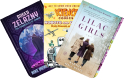
I picked this book up because it was a
modern retelling of the myth of Medusa, told from the point of view of Medusa.
For some reason, there were three books this summer that told the myth from the
Gorgon’s point of view, all by young women who are classical scholars (the
other two are The Shadow of Perseus by Claire Heywood and Medusa’s Sisters by
Lauren J. A. Bear). I wanted to see how Haynes (and the others) would handle
the characterizations and would re-interpret the nominal hero, Perseus, as the
villain of the story.
Some thirty years ago, there was a wave in the women’s movement to adopt Medusa as a symbol of female power and rage, and I was curious about why it seemed to have arisen again. Haynes’ is my favorite
version. She interprets Athena as a somewhat flighty, self-driven being who is
resentful of being asked to help her father, Zeus’ son, whom she views as something
of an idiot. In both Haynes and Heywood, Perseus is a sketchily educated, unsophisticated, insecure teenager who is delusional about his significance.
Naturally, as this is all told by the Gorgons themselves, Perseus, who is
trying to kill Medusa for no good reason, must be a villain.
Very interesting modern
re-takes on a classic myth. Liked
to see how someone else approached what was the topic of one of my own books
** Longlisted for the Women's Prize for Fiction 2023 **
In Stone Blind, the instant Sunday Times bestseller, Natalie Haynes brings the infamous Medusa to life as you have never seen her before.
'Witty, gripping, ruthless' - Margaret Atwood via Twitter 'Beautiful and moving' - Neil Gaiman via Twitter
'So to mortal men, we are monsters. Because of our flight, our strength. They fear us, so they call us monsters.'
Medusa is the sole mortal in a family of gods. Growing up with her Gorgon sisters, she begins to realize that she is the only one who experiences change, the…
I’m a big fan of Jules Verne and have been
trying to read through his body of work. It’s difficult because they keep adding new, previously unpublished, or untranslated works. Verne wrote well over
60 novels, and not all of them were what would be classified as science fiction. Many were
travelogues.
This one was Verne’s homage to Alexandre Dumas’ The Count of Monte Cristo.
He dedicated it to Dumas, and it has an introduction by Dumas’ son, with whom
Verne was a close friend.
Even though it’s not science
fiction, it has a secret code, an elliptical whispering gallery, and submarine-like electrically powered boats (which were really popular when Verne wrote this). There’s the wronged hero, who escapes and is apparently killed but returns to take revenge upon his oppressors, as in Dumas’ story. Well worth a read. It's another Verne book and a well-written and satisfying adventure.
What do you do when your enemies betray you and prosper? Amass a fortune and destroy them one by one. A tribute to Alexandre Dumas' Count of Monte Cristo, Mathias Sandorf is classic Verne. Includes cryptograms, pirates and acrobats.
Trieste, 1867. Two petty criminals, Sarcany and Zirone, intercept a carrier pigeon. They find a ciphered message attached to its leg and uncover a plot to liberate Hungary from Austro-Hungarian rule. The two meet with Silas Toronthal, a corrupt banker, and form a plan to deliver the conspirators to the police in exchange for a rich reward. The three conspirators,…
This is a wonderfully off-the-wall adventure by the author of the Sandman series and co-author of Good Omens. Like those, Gaiman incorporates a lot of mythology and folklore into the work, often in non-obvious ways.
Spotting the mythological references is part of the fun. And, of course, right
up my alley. Interesting take on mythological
characters. And, despite the potentially grim subject matter, it is much lighter in
tone than the Medusa books I cite above.
Destined to be a treasure for the millions of fans who made American Gods an internationally bestselling phenomenon, this beautifully designed and illustrated collectible edition of Neil Gaiman’s revered masterpiece features enlightening and incisive notes throughout by award-winning annotator and editor Leslie S. Klinger.
A perennial favorite of readers worldwide, American Gods tells the story of ex-con Shadow Moon, who emerges from prison and is recruited to be bodyguard, driver, and errand boy for the enigmatic Mr. Wednesday. So begins a dark and strange road trip full of fantastical adventures and a host of eccentric characters. For, beneath the placid…
This is a new and original interpretation
of the origin and meaning of the myth of Perseus and Medusa. It draws on
history, astronomy, psychology, forensic science, and comparative mythology to
suggest what shaped the myth and why the Face of the Gorgon is used around the
world for the same purposes.