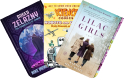
Serial murders in rural Silesia form the backbone of this cunning mystery novel and the backdrop to a self-portrait of a wise, eccentric, opinionated old bag who turns out to be not only quite charming but extraordinarily devious.
Almost completely devoid of sex and drugs, the story mixes lessons in astrology with an impassioned engagement with the poetry of William Blake and resumes his campaign to respect the lives of animals. Crammed full of witty observations of human beastliness, Drive Your Plow is an unusually accomplished detective story, a first-rate animal rights manifesto, and a defense of a person’s right to be different.
You might guess the solution a few pages before the end, but even so, the final reveal is a stunning tour de force. An altogether unique combination of learning, style, insight, and philosophical argument wrapped inside a gripping yarn.
With DRIVE YOUR PLOW OVER THE BONES OF THE DEAD, Nobel Prize in Literature laureate Olga Tokarczuk returns with a subversive, entertaining noir novel. In a remote Polish village, Janina Duszejko, an eccentric woman in her sixties, recounts the events surrounding the disappearance of her two dogs. She is reclusive, preferring the company of animals to people; she's unconventional, believing in the stars; and she is fond of the poetry of William Blake, from whose work the title of the book is taken. When members of a local hunting club are found murdered, Duszejko becomes involved in the investigation. By…
First, because I love the way Roth writes—with simplicity, occasionally with wit, but always with more than one thing going on in a sentence.
Second, because it’s a probably well-informed portrait of the lives led by Jews in late 19C Russia, which sort of interests me because that’s where my grandparents started out. Third, because it’s a story of migration, and with that comes change and betrayal and loyalty and all kinds of American drama.
In sum, a most unusual book from a truly marvelous Austrian writer
An Orthodox Jew encounters his biggest test of faith after moving from Tsarist Russia to New York City in this “pure, perfect” retelling of the Book of Job (Stefan Zweig)
Job is the tale of Mendel Singer, a pious, destitute Eastern-European Jew and children’s Torah teacher whose faith is tested at every turn. His youngest son seems to be incurably disabled, one of his older sons joins the Russian Army, the other deserts to America, and his daughter is running around with a Cossack. When he flees with his wife and daughter, further blows of fate await him .…
I’ve always enjoyed Seethaler’s art of story-telling, and his latest tale of the simple life of an unremarkable man in a now-vanished quarter of Vienna is a quiet triumph.
Indirectly, it’s also a history of the city, and by extension a lament about the way the post-war world has changed. Full of engaging character sketches, this little elegy really charmed me, and I hope it appears soon in English translation.
Ein Café und seine Menschen. Ein Mann, der seiner Sehnsucht folgt. Robert Seethalers neuer Roman.
Wien im Jahr 1966. Robert Simon verdient sein Brot als Gelegenheitsarbeiter auf dem Karmelitermarkt. Er ist zufrieden mit seinem Leben, doch zwanzig Jahre nach Ende des Krieges hat sich die Stadt aus ihren Trümmern erhoben. Überall wächst das Neue, und auch Simon lässt sich mitreißen: Er pachtet eine Gastwirtschaft und eröffnet sein eigenes Café. Das Angebot ist überschaubar, und genau genommen ist es gar kein richtiges Café, doch die Menschen aus dem Viertel kommen und sie bringen ihre Geschichten mit – von Sehnsucht, vom unverhofften…
Copyright is everywhere. In your smartphone, your photos, your wallpaper, and all your books. And what about AI? Copyright is now a baffling construction of overlapping laws that constrain the use of all creative products.
It didn’t have to turn out that way. Arising in eighteenth-century London, copyright only recently became a new enclosure, concentrating ownership of cultural goods. High ideals, low greed, and corporate opportunism have allowed poems, novels, ringtones, databases, and banana costumes to be treated as if they were like farms and houses. Arguments against copyright arose at the start and nearly abolished it, but late twentieth-century revisions made it ever stronger.
Who Owns This Sentence? is a humorous and enlightening history of the idea that intangible things can be owned—the greatest engine of inequality in our own time.