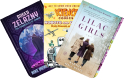
The fall of Empires is always painful regardless of
their nature.
This was definitely the case for Napoleon's ephemeral Western
European multiethnic polity. Within three short years, his imperial dream of
placing Europe under a uniform system collapsed, soaked in blood and consumed by
flames.
This is the final volume of Michael Broers's definitive three-volume history of Napoleon. He combines the erudition of Edward Gibbon in chronicling
the decline and fall of the Napoleonic behemoth with the nostalgia and
sensitivity of Marcel Proust.
An accomplished Oxford scholar delivers a dynamic new history covering the last chapter of the emperor's life-from his defeat in Russia and the drama of Waterloo to his final exile-as the world Napoleon has created begins to crumble around him.
In 1811, Napoleon stood at his zenith. He had defeated all his continental rivals, come to an entente with Russia, and his blockade of Britain seemed, at long last, to be a success. The emperor had an heir on the way with his new wife, Marie-Louise, the young daughter of the Emperor of…
Whether Pius XII
collaborated with Fascism and Nazism during the 1940s remains controversial.
Pope Francis’ decision to open the Vatican’s files relating to the Second World
War in March 2020 has been game-changing. David Kertzer was the first scholar
to access these files and publish an in-depth study on Pope Pacelli’s role
during WWII.
The result has been both moving and disturbing in equal measure.
Kertzer reveals in his lyrically written book the Pope’s disturbing willingness
to negotiate with Hitler and Mussolini, maintaining a rigid diplomatic silence
on the atrocities they committed. Despite this, Pius XII was often willing to
send notes of protest to the Allies and deplore their bombing raids in Italy.
It is a book
that reads like a thriller while upholding the highest standards of
scholarship.
NEW YORK TIMES BESTSELLER • “The most important book ever written about the Catholic Church and its conduct during World War II.”—Daniel Silva
“Kertzer brings all of his usual detective and narrative skills to [The Pope at War] . . . the most comprehensive account of the Vatican’s relations to the Nazi and fascist regimes before and during the war.”—The Washington Post
Based on newly opened Vatican archives, a groundbreaking, explosive, and riveting book about Pope Pius XII and his actions during World War II, including how he responded to the Holocaust, by the Pulitzer Prize–winning author of The Pope…
During the 1820s, Portugal, Spain, Piedmont, Naples, and Greece exploded into revolution.
These events are sorely neglected in the
anglosphere, and it is much to Maurizio Isabelle’s credit to rescue them from
obscurity and place them in their proper post-Napoleonic context.
His work is
comparative history at its finest, and he moves deftly across the Mediterranean, wearing his immense learning lightly. What emerged were military pronunciamentos
that became constitutional revolutions which sought to limit the powers of the
Southern European monarchies.
The cast of characters, including Napoleonic
veterans, adventurers, and Greek pirates, is worthy of a Dumas novel. With
magisterial fairness, Isabella assesses the ultimate failure and legacy of these revolutions, showing how they were a vital checkpoint on the road to
defining representative government and our democratic practices.
An examination of revolutions in the Iberian and Italian peninsulas, Sicily and Greece in the 1820s that reveals a popular constitutional culture in the South
After the turbulent years of the Napoleonic Wars and the Congress of Vienna's attempt to guarantee peace and stability across Europe, a new revolutionary movement emerged in the southern peripheries of the continent. In this groundbreaking study, Maurizio Isabella examines the historical moment in the 1820s when a series of simultaneous uprisings took the quest for constitutional government to Portugal, Spain, the Italian peninsula, Sicily and Greece. Isabella places these events in a broader global…
My book Losing a
Kingdom, Gaining the World, explores the epic history of the Roman Catholic church in
the Age of Revolution. Before 1870, the Pope was a secular prince in central
Italy.
Catholicism was not merely a religion but also a political force to be
reckoned with. After the French Revolution, the Church retreated into a
fortress of unreason and denounced almost every aspect of modern life. The Pope
proclaimed his infallibility; the Virgin Mary’s apparitions became articles of
faith; the Vatican refused all accommodation with the modern state. During these dark
days, he threatened the existence of the Church.
As Catholicism lost its temporal
power, it made significant strides and expanded across continents. Between 1700
and 1903, it lost a kingdom but gained the world.