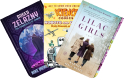
Samantha Harvey has said that she wanted to write a sort of "space pastoral." Inspired by J.L. Carr's A Month in the Country (a book about a veteran of World War I coming back to life in the English countryside), she says she wanted to do something similar about space: "a brief, lovely homage to the natural world, pastoral writing about how deeply humans respond to our natural environments and the relationship between beauty and survival." In the end the book she wrote is quite different from Carr's book: it is an account of four astronauts and two cosmonauts over one day and 16 trips around the earth, but reading it evokes a similar feeling of awe and, yes, peace.
There is no plot to speak of, this is not a thriller, big questions like What are we doing to the earth? and What is the meaning of life? hover over the descriptions of life on the International Space Station. Yet I found it to be the most thought-provoking and satisfying book I read this year.
Winner of the 2024 Hawthornden Prize Shortlisted for the 2024 Orwell Prize for Political Fiction Shortlisted for the 2024 Ursula K. Le Guin Prize for Fiction
A singular new novel from Betty Trask Prize-winner Samantha Harvey, Orbital is an eloquent meditation on space and life on our planet through the eyes of six astronauts circling the earth in 24 hours
"Ravishingly beautiful." — Joshua Ferris, New York Times
A slender novel of epic power, Orbital deftly snapshots one day in the lives of six women and men traveling through space. Selected for one of…
Station Eleven was published just before the Covid 19 pandemic changed lives all over the world. That was a bit of fortuitous timing since it takes place during and after a much more deadly virus sweeps through populations. As such, many readers found the book almost comforting because it imagined not only what happens in a pandemic, but what happens aftewards. Reading the book now that Covid is disappearing into the past might seem a bit like reading newspapers from years ago--that is, reading Old News. But on the contrary doing so opens up views of human resilience that give hope in times that are dangerous in other ways, and the importance of the arts in making us decent human beings.
'Best novel. The big one . . . stands above all the others' - George R.R. Martin, author of Game of Thrones
Now an HBO Max original TV series
The New York Times Bestseller Winner of the Arthur C. Clarke Award Longlisted for the Baileys Women's Prize for Fiction National Book Awards Finalist PEN/Faulkner Award Finalist
What was lost in the collapse: almost everything, almost everyone, but there is still such beauty.
One snowy night in Toronto famous actor Arthur Leander dies on stage whilst performing the role of a lifetime. That same evening a deadly virus touches down in…
I see that the three books I liked the most this year all could be called "science fiction" in that they deal with some aspect of science. Sean Michael's book is an exploration of how artificial intelligence and poetry might interact, but it's far from being a simple speculative tale about dangers of AI gone rogue. At its heart is the question of what art is, and the story left me pondering that, even as I delighted in finding resemblances between Michael's characters and the world of technology.
Scotiabank Giller Prize winner Sean Michaels writes a moving, innovative novel about an ageing poet laureate who "sells out" by agreeing to collaborate with a Big Tech company's poetry AI.
Do You Remember Being Born? is sensitively narrated by the ageing, world-renowned poet Marian Ffarmer. Marian's pristine life of the mind for which she's sacrificed nearly all personal relationships, from romance to friendship to showing up for her son, is interrupted one day by a cryptic invitation from a tech giant.
"Come to California", the invitation beckons, and write with a machine. The Company's lucrative offer for Marian…
What can we learn about coping with rising sea levels from ancient times?
The scenario we are facing is scary: within a few decades, sea levels around the world may well rise by a metre or more as glaciers and ice caps melt due to climate change. Large parts of our coastal cities will be flooded, the basic outline of our world will be changed, and torrential rains will present their own challenges. But this is not the first time that people have had to cope with threatening waters, because sea levels have been rising for thousands of years, ever since the end of the last Ice Age. Stories told by the Indigenous people in Australia and on the Pacific coast of North America, and those found in the Bible and the Epic of Gilgamesh, as well as Roman and Chinese histories all bear witness to just how traumatic these experiences were. The responses to these challenges varied: people adapted by building dikes, canals, and seawalls; by resorting to prayer or magic; and, very often, by moving out of the way of the rushing waters.
Against the Seas explores these stories as well as the various measures being taken today to combat rising waters, focusing on five regions: Indonesia, Shanghai, the Sundarbans of Bangladesh, the Salish Sea, and the estuary of the St. Lawrence River. What happened in the past and what is being tried today may help us in the future and, if nothing else, give us hope that we will survive.
The book also is the starting point for Soderstrom's next book Before We Forget: How Remembering Will Get Us Through the Next 75 Years, which Dundurn Press will publish in March 2026.