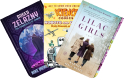
This novel is the most captivating I have read in a long while. I stumbled upon the film adaptation last summer and liked it enough to give the book a chance. I was not disappointed. The Marsh King’s Daughter, a clever modern-day adaptation of Hans Christian Andersen's eponymous fairy tale, is set in Michigan's Upper Peninsula and tells the story of a plucky young girl raised in an isolated cabin by her mother's kidnapper. She does not know anything about the crime and looks up to her father who teaches her to trap, track and hunt. When the truth comes out and she flees the marsh with the timorous mother she long despised, her perspective shifts and she is transformed by this truth. The narration provided by the daughter, Helena, offers a fine suspense, but is also a fascinating exploration of Michigan’s marsh ecosystem. Dionne lives in the Upper Peninsula herself, and her extensive knowledge of its environment shows.
You'd recognise my mother's name if I told it to you. You'd wonder, briefly, where is she now? And didn't she have a daughter while she was missing?
And whatever happened to the little girl?
Helena's home is like anyone else's. With a husband and two daughters, and a job she enjoys. But no one knows the truth about her childhood.
Born into captivity and brought up in an isolated cabin until she was 12, Helena was raised to be a killer by the man who kept her captive - her own father.
I began working on an art project about the coming technocracy last winter, and decided to read more about artificial intelligence to clarify my ideas. I was already upset about planned obsolescence, AI-generated artwork and brain rot and needed to understand where we were heading as a society. I had listened to some of John Lennox's lectures on the subject and bought his book to delve deeper. What Lennox's essay made me realize is how dangerously advanced AI technologies already are, and how this is allowed to happen by wealthy technocrats who embrace artificial intelligence and transhumanism as the next steps in human evolution. In other words, naturally created human beings are seen as archaic and will inevitably be replaced. Providing abundant examples of disturbing uses of artificial intelligence in education and the military, as well as positive ones in regards to medicine, Lennox's work acts as a warning to take it slow when it comes to implementing technologies that could soon outsmart us. A grim but necessary read.
You don't have to be a computer scientist to have discerning conversations about artificial intelligence and technology. We all wonder where we're headed. Even now, technological innovations and machine learning have a daily impact on our lives, and many of us see good reasons to dread the future. Are we doomed to the surveillance society imagined in George Orwell's 1984?
Mathematician and philosopher John Lennox believes that there are credible answers to the daunting questions that AI poses, and he shows that Christianity has some very serious, sensible, evidence-based responses about…
Scottish missionary Mary Slessor wrote in 1909: "How little those who lightly throw it aside realize what they owe the Gospel." I had heard of Tom Holland's book Dominion from many intellectuals and finally read it this year. Having been raised Christian in Québec's post-catholic culture, I am used to most of my fellow men taking the transformations Christianity has brought for granted and affirming that throwing the baby away with the bath water was the right decision. As many in the West are noting that their secular cut flower societies are withering away, this examination of Christianity's role in shaping our civilization demonstrates how our ingrained notions of freedom, justice and compassion did not appear in a vacuum. Holland shows both constructive and destructive elements Christians have brought to their nations through history. Not a believer himself, his objective take is surprising, and even though I do not always agree with his interpretation, I still think it is a must-read.
The Sunday Times bestseller, with a new introduction by Nassim Nicholas Taleb
'If great books encourage you to look at the world in an entirely new way, then Dominion is a very great book indeed' Dominic Sandbrook, Sunday Times History Book of the Year 'Terrific: bold, ambitious and passionate' Peter Frankopan
Dominion tells the epic story of how those in the West came to be what they are, and why they think the way they do. Ranging from Moses to Merkel, from Babylon to Beverley Hills, from the emergence of secularism to the abolition of slavery, it explores why, in…
When a deathbed confession leads RCMP Constable Jasper Nelson to discover the existence of his illegitimate sister, his curiosity is piqued and he sets out to find her. He locates the young woman a year later where he least expects to, within the police force itself.
As the geographical distance separating them becomes unbearable, Nelson obtains a transfer from Vancouver to the Inuvik detachment where he partners with his hardy sibling Heidi Finlay to investigate criminal activity and trauma in the High Arctic. Inspired by actual events, On Duty is a series of cases narrated by the Mounties themselves; through Nelson’s refined prose and Finlay’s no-nonsense reporting, a portrait of human nature emerges, emphasizing the possibility—and need—for divine redemption.