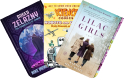
I love memoirs. I've read many and written one myself. Catherine Gildiner’s tale of her preteen years is a cut above. Too Close to the Falls begins unassumingly with an assortment of mildly amusing tales but soon ushers in several surprises. Characters that I thought we were done with had a habit of reappearing, providing nuance and depth to Catherine's slightly unusual circumstances. Superficially entertaining anecdotes led to deeper, more disturbing material; a cameo from Marilyn Monroe provides a spark of decadent glamour, but Gildiner is not content with reality as perceived by a child. The child matures, and so too the reader. It isn't long until Gildiner, both author and child, is probing the dark underbelly of sleepy Lewiston, New York, and the nature of humanity along with it, where unfortunate realities are all too easily unearthed.
Welcome to the childhood of Catherine McClure Gildiner. It is the mid-1950s in Lewiston, New York, a sleepy town near Niagara Falls. Divorce is unheard of, mothers wear high heels to the beauty salon, and television has only just arrived.
At the tender age of four, Cathy accompanies Roy, the deliveryman at her father's pharmacy, on his routes. She shares some of their memorable deliveries-sleeping pills to Marilyn Monroe (in town filming Niagara), sedatives to Mad Bear, a violent Tuscarora chief, and fungus cream to Warty, the gentle operator of the town dump. As she reaches her teenage years, Cathy's…
This is the second time I've read Wild Seed. The first time I read it, I found it a page turner. I liked it so much that I loaned it to a friend, who must also have loved it, because they never gave it back. I didn't mind. I hope they gave it to someone else when they were done with it, because Wild Seed deserves a wide audience.
After many years, I bought myself another copy, and still found it a page turner. Butler has crafted a compelling heroine with unique abilities who still manages to be utterly human and relatable. The latter two characteristics also describe several of the supporting players; Butler takes pains to properly flesh them out. Even the villain's motivations are understandable, given his nature and history. This is one of a handful of books I recommend to others utterly without reservation.
I like books for children that work on multiple levels, that can be enjoyed by people of all ages, such as Peter Pan, Alice in Wonderland, The Wind in the Willows, and, now... The Wild Robot. The book version of The Wild Robot is pitched a bit more toward younger readers than the film version, but adults can still appreciate it. Especially adults like me, who love stories about robots. All those Asimov books and short stories I read as a kid, I guess. I enjoyed seeing the author's original illustrations, which are charming. The Wild Robot is one of those tales that introduces kids in a gentle, imaginative way to the complexities of life they'll inevitably encounter as they get older, such as mortality and parenthood, and it touches upon themes of technology and industrialization versus nature, but really it's just a great adventure story about a cool robot and its talking animal friends. I wish I'd had the chance to read it as a kid, because I'm sure I would have adored it even more.
'An engaging tale that explores many important themes. We can only hope that Roz serves as the template for all future robots. Peter Brown's illustrations are as marvellous as ever!' Coralie Bickford-Smith, author of THE FOX AND THE STAR
When robot Roz opens her eyes for the first time, she discovers that she is alone on a remote, wild island. She has no idea how she got there or what her purpose is - but she knows she needs to survive. After battling a fierce storm and escaping a vicious bear attack, she realises that her only hope for survival…
A lonely, mild-mannered English teacher from Prince Edward Island, Barnabus J. Wildebear, gets caught up in a quest by a thousand-year-old alien to find the ancient evil responsible for killing its people:
Barnabus’s nephew is behaving oddly.
Calling upon Doctor Humphrey for assistance has not been particularly helpful, because the good doctor’s diagnosis of demonic possession is clearly preposterous. Even the demon currently ensconced on the front room couch agrees it’s preposterous. But then, how else to explain the portal to another world through which his nephew and Humphrey have just now disappeared? Barnabus knows their only chance of rescue is for Barnabus J. Wildebear himself to step up and go through that portal.
Thus begins an existential romp across space and time, trampling on Barnabus’ assumptions about causality, freewill, identity, good and evil. Can Barnabus save his nephew—and incidentally, all of humanity?