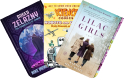
Loving and learning so much from historical photographs, this dystopian novel is close to my heart because it is about the dangers of contemporary technological video surveillance and control. Two children return home and find the house is surrounded by a painted red line. The children have become undesirables or ‘unverifieds’ probably because of their activist mother. They must leave but cannot risk being seen or overheard on camera and cannot use any devices themselves. Finding a vacant house in which to squat they meet an elderly woman Oona who teaches them how to forage and live under the radar. Gliff is the name of a horse they adopt to prevent his death in an abattoir. The relationships between all three are moving and sustaining. Relying on memory rather than technology, the children learn to live and survive in this Brave New World.
Written by Lee Miller’s son, the book brings to life one of the twentieth century’s great photographers. The actress Kate Winslet claims that the book inspired her to create the 2024 prize-winning film Lee in which Winslet stars as Lee and portrays all of Miller’s multiple lives: as model, as friend of Picasso and other artists, and as a war photographer. An immensely talented photographer, Lee’s move from Vogue cover model to documenting the liberation of Dachau after WWII matches the turbulent moments of her time and is an inspiration.
Described by the Sunday Times as 'a fascinating revelation of an adventurous and protean spirit', this biography is the inspiration behind the 2024 film Lee, starring Kate Winslet as Lee Miller.
Beautiful, bewitching and an exceptionally good photographer, Lee Miller was one of life's adventurers.
She became a Vogue cover girl in 1920s New York before embracing Paris, photography and Surrealism, and then dramatically changed her life yet again, reinventing herself as a war correspondent, notably covering the liberation of Dachau.
These are but three of the many lives of Lee Miller, intimately recorded here by her son, Antony Penrose.…
John Berger is one of the most humane and brilliant writers on photography. Understanding a Photograph is so much more than a description of how photographs work, although it is also that. Berger’s essays about major photographers, like Henri Cartier-Bresson, help us see the world around us in new and fascinating ways and teach us how to read the media afresh. I use Berger’s insights in my own writings, particularly in The Bloomsbury Photographs, because they are genuinely inspiring.
John Berger's writings on photography are some of the most original of the twentieth century. This selection contains many groundbreaking essays and previously uncollected pieces written for exhibitions and catalogues in which Berger probes the work of photographers such as Henri Cartier-Bresson and W. Eugene Smith - and the lives of those photographed - with fierce engagement, intensity and tenderness.
The selection is made and introduced by Geoff Dyer, author of the award-winning The Ongoing Moment.
How do we see the world around us? This is one of a number of pivotal works by creative thinkers whose writings on art,…
An enthralling portrait of the Bloomsbury Group’s key figures told through a rich collection of intimate photographs
Photography framed the world of the Bloomsbury Group. The thousands of photographs surviving in albums kept by Virginia Woolf, Vanessa Bell, Dora Carrington, and Lytton Strachey, among others, today offer us a private insight into their lives.
The Bloomsbury Photographs brings together over 160 of these photographs to offer us a fresh portrait of the Bloomsbury Group, showing them in a new, domestic intimacy. The book brings to life the texture of Bloomsbury: their pastimes, children, clothes, houses, servants, pets, holidays. Unguarded close-ups reflect complex personal relationships. The Bloomsbury Photographs are not simply documents, but testimonies of relationships, friendships, and the significance of historical lives. https://yalebooks.co.uk/book/9780300273755/the-bloomsbury-photographs/