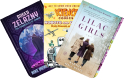
A deeply moving examination of mortality through an unexpected lens. The direct--"this is normal"--voice of the main character/narrator, as against the reader's slowly emerging awareness that things are anything but normal was extraordinarily powerful. Books do not make me cry; this book came as close as possible.
One of the most acclaimed novels of the 21st Century, from the Nobel Prize-winning author
Shortlisted for the Man Booker Prize
Kazuo Ishiguro imagines the lives of a group of students growing up in a darkly skewed version of contemporary England. Narrated by Kathy, now thirty-one, Never Let Me Go dramatises her attempts to come to terms with her childhood at the seemingly idyllic Hailsham School and with the fate that has always awaited her and her closest friends in the wider world. A story of love, friendship and memory, Never Let Me Go is charged throughout with a sense…
This is just the best combination of personal narrative with important history, history I lived through myself. Getting to know both the author--Doris Kearns Goodwin--and her late husband--Dick Goodwin--and each of their extraordinary political experiences during the 1960s was great, and I learned much about the 1960s--that I lived through--that I never knew. Great!
This is a very unusual introduction to the history of philosophy that brings a deep and powerful sense of how major contributions to philosophy over two millennia were fully intertwined in their historical settings. It significantly upsets the standard, "Plato to NATO," story that is told of philosophy.
'Astonishing ... enjoy its riches slowly, and savour every generous, erudite and undogmatic page' Boyd Tonkin, Financial Times
'We English men have wits,' wrote the clergyman Ralph Lever in 1573, and, 'we have also framed unto ourselves a language.'
Witcraft is a fresh and brilliant history of how philosophy became established in English. It presents a new form of philosophical storytelling and challenges what Jonathan Ree calls the 'condescending smugness' of traditional histories of philosophy. Ree tells the story of philosophy as it was lived and practised, embedded in its time and place, by men and women from many walks…
Western philosophers have traditionally concentrated on theory as the means for expressing knowledge about a variety of phenomena. This absorbing book challenges this fundamental notion by showing how objects themselves, specifically scientific instruments, can express knowledge. As he considers numerous intriguing examples, Davis Baird gives us the tools to "read" the material products of science and technology and to understand their place in culture. Making a provocative and original challenge to our conception of knowledge itself, "Thing Knowledge" demands that we take a new look at theories of science and technology, knowledge, progress, and change. Baird considers a wide range of instruments, including Faraday's first electric motor, eighteenth-century mechanical models of the solar system, the cyclotron, various instruments developed by analytical chemists between 1930 and 1960, spectrometers, and more.