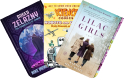
A good test of whether I really love a book or just like it is whether I feel a certain grief upon finishing it, whether I miss the company of the characters and the plot. Reading Buddenbrooks for the second time, I found myself feeling depressed at the prospect of finishing the book with 200 pages left to read.
The story of a family, of triumphs and losses, over several generations, quickly becomes part of the reader’s own life story.
Discover Mann's Nobel Prizewinning semi-autobiographical and sweeping family epic.
The Buddenbrook clan is everything you'd expect of a nineteenth-century German merchant family - wealthy, esteemed, established. Four generations later, a tide of twentieth-century modernism has gradually disintegrated the bourgeois values on which the Buddenbrooks built their success.
In this, Mann's first novel, his astounding, semi-autobiographical family epic, he portrays the transition of genteel Germanic stability to a very modern uncertainty.
'Perhaps the first great novel of the 20th century' New York Times
In a world torn by wars, Jonathan Shay offers a stunning cross-fertilization of the Homeric universe of the Iliad with the experiences of today’s soldiers on the battlefield.
Shay, a psychiatrist with a long experience of treating Vietnam veterans and a profound knowledge of Homer, achieves a remarkable double feat; he shows how the Iliad’s accounts of the battlefield provide unique insights into the experiences of today’s warriors and also how these experiences offer a profound understanding of the metamorphosis of Achilles from noble and generous hero into a demented killing machine.
He identifies the betrayal of "What is Right" and the failure to grieve for the loss of a battlefield friend as crucial elements in a soldier’s rage (what he calls "berserkness") and its subsequent cause of insuperable psychopathologies.
An original and groundbreaking book that examines the psychological devastation of war by comparing the soldiers of Homer’s Iliad with Vietnam veterans suffering from post-traumatic stress disorder.
In this moving, dazzlingly creative book, Dr. Shay examines the psychological devastation of war by comparing the soldiers of Homer’s Iliad with Vietnam veterans suffering from post-traumatic stress disorder.
A classic of war literature that has as much relevance as ever in the wake of the wars in Iraq and Afghanistan, it is a “transcendent literary adventure” (The New York Times) and “clearly one of the most original and most important scholarly…
This book offers a panorama of the Austro-Hungarian empire from the mid-nineteenth century to its collapse in the aftermath of World War I through the lives of three generations of minor provincial nobility. With the possible exception of War and Peace, there are few better examples of the intertwining of personal lives with world events.
The book offers a striking account of the inner life of a ruler, Emperor Franz-Josef, and a deeply felt account of the decay and collapse of an empire.
THE RADETSKY MARCH is subtle and touching study of family life at the end of the Austro-Hungarian Empire. Writing in the traditional form of the family saga, Roth nevertheless manages to bring to his story a completely individual manner which gives at the same time the detailed and intimate portrait of a life and the wider panorama of a failing dynasty. Not yet well known in English-speaking countries, Joseph Roth is one of the most distinguished Austrian writers of our century, worthy to be bracketed with Musil and Kraus.
This is a book about the stories that music tells and the beauty and emotional power of these stories. When successful, these stories can provide dazzling insights into the lives that we lead, with their joys and sufferings.
This book offers a panorama of musical stories linked to pieces of classical music that have long been part of my life, including operas, symphonies, song cycles, and chamber music.
A close reading of these stories shows how profoundly music can affect and change the listeners: how it celebrates the triumphs of the human spirit, opening windows into our own unconscious minds, helping us to better understand ourselves, our fellow human beings, politics, religion, leadership, sex, difference, love, death, and every other major aspect of human life.