Macfarlane took me under the earth: I climbed with him
into dark caves miles deep, into prehistoric burial sites 65,000 years old,
into the understory of living creatures just beneath our feet and the wide web
of the forest that connects all trees into a community, and into underground spaces where physicists unravel the cosmos searching for dark
matter.
I now know there is a doomsday vault in the Arctic that preserves ninety
million seeds for a post-apocalyptic future. I can never look at trees, the earth, or the cosmos in the same way. He
warns of “species loneliness” if extinctions continue. But Macfarlane offers
hope.
The world is utterly precious. Mystery abounds. There is so much to
discover.
In Underland, Robert Macfarlane delivers an epic exploration of the Earth's underworlds as they exist in myth, literature, memory, and the land itself. Traveling through the dizzying expanse of geologic time-from prehistoric art in Norwegian sea caves, to the blue depths of the Greenland ice cap, to a deep-sunk "hiding place" where nuclear waste will be stored for 100,000 years to come-Underland takes us on an extraordinary journey into our relationship with darkness, burial, and what lies beneath the surface of both place and mind.
Global in its geography and written with great lyricism, Underland speaks powerfully to our…
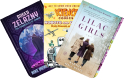
Nothing is more delightful than
reading about improbable lives. In her biography of Louise de
Kiriline Lawrence, Merilyn Simonds writes about a woman
whose life could not be predicted.
She was born in Sweden into a wealthy
aristocratic family. Trained as a nurse, when she was twenty-three, she fell in
love with a White Russian POW in a Swedish rehab camp and followed him back to
his country in 1918. Captured by the Bolsheviks, the couple were separated.
Louise waited 4 years in Moscow before accepting that he’d been executed.
She moved to the isolation of Northern
Ontario and became a well-known ornithologist, writing six books and over one
hundred articles. What makes this book wonderful is Simonds’s passionate enthusiasm,
her knowledge as a birder, and her exquisite writing.
From award-winning author Merilyn Simonds, a remarkable biography of anextraordinary woman ― a Swedish aristocrat who survived the Russian Revolution to become an internationally renowned naturalist, one of the first to track the mid-century decline of songbirds.
2022 Foreword Indies Award Winner for the Editor’s Choice Prize, non fiction
“[A] lyrical, passionate, and deeply researched portrait.” ― Margaret Atwood
“This brilliant account does justice to a pioneering figure who merits wider recognition.” ― Publishers Weekly, starred review
“[A] marvelous biography of a true pioneer of ornithology.” ― Booklist, starred review
“Woman, Watching is an entrancing blend of biography, memoir, history,…
Labatut has called his book “a work of fiction based
on real events.” His personages are scientists, fascinating in their
obsessions.
There are 5 sections to the book; they deal with brilliance and
madness. Fritz Haber who pioneered the use of chlorine gas, which evolved into
Zyklon B later used to kill millions in the Nazi concentration camps, seemed to
have had no regrets about his discovery, but his wife committed suicide. The
physicist who conjectured the existence of black holes died in a military
hospital in 1915 from a skin infection, possibly cause by poison gas.
The book
seems to despair at the human capacity for destruction.
When We Cease to Understand the World shows us great minds striking out into dangerous, uncharted terrain.
Fritz Haber, Alexander Grothendieck, Werner Heisenberg, Erwin Schroedinger: these are among the luminaries into whose troubled minds we are thrust as they grapple with the most profound questions of existence. They have strokes of unparalleled genius, they alienate friends and lovers, they descend into isolated states of madness. Some of their discoveries revolutionise our world for the better; others pave the way to chaos and unimaginable suffering. The lines are never clear.
At breakneck pace and with wondrous detail, Benjamin Labatut uses the…
During the Covid lockdown, I compiled a collection
of journeys I’d written about over the years. There were so many of them: trips
to Russia, Czechoslovakia, England, India, Egypt, Cuba, Chile, Mexico, France, and Greece.
I wrote the outlandish story of the murder in our Moscow
Airbnb while researching Stalin’s Daughter. I traveled to Chile during Augusto Pinochet’s regime, talking to writers. I followed D.
H. Lawrence to visit the Etruscan tombs. Sometimes, I was trying to
reinvent myself, attending a Sufi summer camp or exploring the trail of my
ancestors. I ended my travels in the Great Bear Rainforest, astonished by the beauty of the wild.
I’ve been a traveler all my life.
Organizing these journeys chronologically, I’ve discovered they describe who I
am.