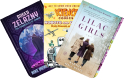
Have you ever seen the devil?
Dostoevsky did. At a grand ball, he glimpsed one of the guests, tucking his tail
into his trousers on the way out.
The Dostoevsky who emerges from Christofi’s
biography is a haunted, conflicted, deeply flawed character. It is remarkable
that he was able to write at all when he was in the depths of his ruinous gambling
addiction. Yet from this consciousness came some of the most powerful and
prescient novels ever written.
Christofi’s book significantly increased my fascination
with this extraordinary writer and human being.
'A daring and mesmerizing twist on the art of biography' - Douglas Smith, author of Rasputin: The Biography 'Anyone who loves [Dostoevsky's] novels will be fascinated by this book' - Sue Prideaux, author of I Am Dynamite! A Life of Friedrich Nietzsche Dostoevsky's life was marked by brilliance and brutality. Sentenced to death as a young revolutionary, he survived mock execution and Siberian exile to live through a time of seismic change in Russia, eventually being accepted into the Tsar's inner circle. He had three great love affairs, each overshadowed by debilitating epilepsy and addiction to gambling. Somehow, amidst all…
I’m a huge fan of Werner Herzog, the director who gave
us cinematic treats such as Fitzcarraldo and Bad Lieutenant, as well as startling documentaries like Grizzly Man.
As a multi-decade
resident of Japan, I’ve been long intrigued by the story of Hiroo Onoda, the
Japanese soldier who continued to patrol a remote island in the Philippines
until he finally surrendered in 1974. Herzog’s first novel puts you inside the
head of Onoda, a man that many would consider crazy, and makes you understand the
obsessive logic of his worldview and marvel at his survivalist skills.
It’s a
short book, but it made me think about how we construct the collective illusion we
call reality. Those who refuse to accept it – like Onoda and the hero of Fitzcarraldo – we call madmen or geniuses.
'A potent, vaporous fever dream; a meditation on truth, lies, illusion and time' NEW YORK TIMES
In his first novel, the great filmmaker, Werner Herzog, tells the incredible story of a Japanese soldier who defended a small island for twenty-nine years after the end of World War II.
Hold the island until the Imperial army's return. You are to defend its territory by guerrilla tactics, at all costs... There is only one rule: you are forbidden to die by your own hand. In the event of your capture by the enemy, you are to give them all the misleading information…
Who would have thought that the teenage Robert Zimmerman, later known as Bob Dylan, belonged to his high school Latin club? Richard Thomas, who found the evidence, was
not so surprised.
A Professor of Ancient Greek and Roman poetry at Harvard and a long-standing fan, he has traced Dylan’s increasing use of classical
allusions. The singing Nobel prizewinner’s favorite is Ovid, whose phrases he
has used over 30 times in his lyrics. “Ancient footsteps are everywhere,” to
quote his song “When I Paint My Masterpiece.”
Thomas’s book is personal and easy
to read, casting new light on the enigmatic 82-year-old. As a committed fan
myself, I can safely say it is the best Dylan book yet, leaving out the ones he
authored himself.
A GUARDIAN AND INDEPENDENT BEST MUSIC BOOK OF THE YEAR
'At last an expert classicist gets to grips with Bob Dylan' Mary Beard
'Thomas's elegant, charming book offers something for everyone - not just the super-fans' Independent
When the Nobel Prize for Literature was awarded to Bob Dylan, the literary world was up in arms. How could the world's most prestigious book prize be awarded to a famously cantankerous singer-songwriter in his Seventies, who wouldn't even deign to make an acceptance speech?
In Why Dylan Matters, Harvard Professor Richard F. Thomas answers that question with magisterial…
On Kurosawa explores the work and life of Akira Kurosawa, including all 30 films he directed, a dozen that he scripted or co-scripted for other directors, and key episodes and themes in his personal history.
Amongst these are the rupture with his great leading man, Toshiro Mifune, the suicide of his brother, his women, his war, and his concept of the samurai in contrast to Yukio Mishima’s.
Writing this book was a huge thrill, as I immersed myself in Kurosawa’s world for months on end and created a memento of the experience, including artwork featuring his personal seal and rare photos. Sometimes, I felt he was standing right behind me.