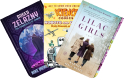
What stands out for me in Small Mercies is the intensity of
Lehane’s writing.
Like his earlier masterpiece, Mystic River, it is a tragic story of working-class people in South
Boston, propelled by the loss of a protagonist’s beloved daughter. The added twist
in Small Mercies is that it ties into
the real-life history of court-imposed school busing in Boston to desegregate
Boston schools.
We see this happening through the eyes of Mary Pat Fennessy, a
fierce busing opponent, while also sharing the experiences of Black
participants in those events, and while Mary Pat also goes to war against South
Boston criminals who are ruining the lives of people around her.
I heard Lehane
say at a book signing that working-class stories are inevitably tragic. As an
exploration of rage, revenge, and grief, Small
Mercies provides a memorable example.
“Small Mercies is thought provoking, engaging, enraging, and can’t-put-it-down entertainment.” — Stephen King
The acclaimed New York Times bestselling writer returns with a masterpiece to rival Mystic River—an all-consuming tale of revenge, family love, festering hate, and insidious power, set against one of the most tumultuous episodes in Boston’s history.
In the summer of 1974 a heatwave blankets Boston and Mary Pat Fennessy is trying to stay one step ahead of the bill collectors. Mary Pat has lived her entire life in the housing projects of “Southie,” the Irish American enclave that stubbornly adheres to…
As expected from this author,
this book is very funny in parts, but it’s also alarming as
commentary on decline in our political leadership.
Borowitz chronicles the emergence of
ignorance and stupidity as political credentials rather than disqualifiers,
starting with Reagan, flowering with Dan Quayle and GWBush and Sarah Palin, and
surpassing absurdity with the multiply-impeached and indicted former president
and his imitators and sycophants.
Borowitz makes the point that public
ignorance is no longer the embarrassment that it once was, but the opposite,
becoming a criterion for electability that shows commonality with an electorate
for whom knowing what you are talking about is seen as elitist. There’s a lot
of blame to go around for this, but whatever the reasons, Borowitz is depressingly
convincing that it doesn’t bode well for US democracy.
NEW YORK TIMES BESTSELLER * WALL STREET JOURNAL BESTSELLER *WASHINGTON POST BESTSELLER *
Andy Borowitz, "one of the funniest people in America" (CBS Sunday Morning), brilliantly "chronicles our embrace of anti-intellectualism" (Walter Isaacson) in American politics, from Ronald Reagan to Dan Quayle, from George W. Bush to Sarah Palin, to its apotheosis in Donald J. Trump.
Andy Borowitz has been called a "Swiftian satirist" (The Wall Street Journal) and "one of the country's finest satirists" (The New York Times). Millions of fans and New Yorker readers enjoy his satirical news column "The Borowitz Report." Now, in Profiles in Ignorance,…
Also known as Tokyo Station (in the UK), December 6 by Martin Cruz Smith
introduces us to Japan prior to its attack on Pearl Harbor. While Cruz Smith is
a reliably excellent writer, he outdoes himself with this novel which builds
slowly and powerfully to its conclusion.
He introduces us to movers and shakers
in pre-war Japan in the overlapping worlds of night club entertainers, criminals,
political and military leaders, and journalists and diplomats, all through the
eyes of an American who grew up in Japan and understands and lives as Japanese
while also remaining, unavoidably, a foreigner in a country that is
increasingly isolated, paranoid, and militaristic, and that is on what seems an
unalterable path towards total war.
The story held my attention to its
concluding sentence that wonderfully echoes the last sentence in The Great Gatsby. Truly a great read!
From Martin Cruz Smith, author of Gorky Park and Havana Bay, comes another audacious novel of exotic locales, intimate intrigues and the mysteries of the human heart: December 6. Set in the crazed, nationalistic Tokyo of late 1941, December 6 explores the coming world war through the other end of history's prism -- a prism held here by an unforgettable rogue and lover, Harry Niles. In many ways, Niles should be as American as apple pie: raised by missionary parents, taught to respect his elders and be an honorable and upright Christian citizen dreaming of the good life on the…