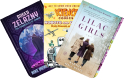
I relish fiction that leads me beyond genre
into unanticipated regions while enquiring into the great questions. In this
regard, this book excels.
It opens as a noir mystery thriller involving a
missing passenger on a submerged jet, then follows salvage diver Robert
Western’s attempts to unravel the threads of his life as he is shadowed by
government agents and haunted by the loss of his psychotic, demon-plagued
sister, Alicia.
There are allusions to an illicit love, memories of a deceased
father involved in the creation of the atomic bomb, of mysterious deaths… Solving the mystery is never the point. Rather, we travel with Western on a
frequently mystifying, sometimes dark and profound journey across America into
Europe and deep into his mind as, it may be, a passenger of life. Reality can fracture; uncertainty, reflection, grief and estrangement are the most constant
companions.
McCarthy’s prose is elegant, brooding, quite
often mesmerizing. His scenic descriptions are unsurpassed. I have
read the novel twice and will do so again. It’s a modern masterpiece.
NEW YORK TIMES BEST SELLER • The Pulitzer Prize–winning author of The Road returns with the first of a two-volume masterpiece: The Passenger is the story of a salvage diver, haunted by loss, afraid of the watery deep, pursued for a conspiracy beyond his understanding, and longing for a death he cannot reconcile with God.
A NEW YORK TIMES BEST BOOK OF THE YEAR
“McCarthy returns with a one-two punch...a welcome return from a legend." —Esquire
Look for Stella Maris, the second volume in The Passenger series.
1980, PASS CHRISTIAN, MISSISSIPPI: It is three in the morning when Bobby Western…
World
myths have intrigued me since my teenage years and in various forms have
underscored much of my fiction. The exclusion of the goddess from modern
religion and culture and its many ramifications is something I have explored
in my novels, albeit set in an imagined world.
Returning to the topic recently, certainly one of the most comprehensive books
on the topic I’ve read is The Myth of the Goddess. It’s a painstakingly
researched, scholarly but highly accessible exploration and deep investigation
into the many (yet essentially one) goddess figures of ancient cultures. It
carries us from the Paleolithic age through the emerging cultures of Crete,
Sumeria, Egypt, Babylon, Greece and more, to the advent of Judaeo-Christian
monotheism, the assembling of the patriarchal superstructure, the Gnostic Sophia, the
Catholic cult of Mary and western civilization’s consequent disconnection from the
natural world.
It’s a hefty tome but is engagingly and enjoyably written and includes multiple
illustrations and an extensive bibliography and appendices. A crucial reading for
anyone interested in the evolution of culture, consciousness, archaeology, history,
religion, and belief.
A comprehensive, scholarly accessible study, in which the authors draw upon poetry and mythology, art and literature, archaeology and psychology to show how the myth of the goddess has been lost from our formal Judeo-Christian images of the divine. They explain what happened to the goddess, when, and how she was excluded from western culture, and the implications of this loss.
I
love to travel and am fascinated by the world we live in and its astonishing
diversity of cultures. Iran is a country I’ve yet to visit, and this book is a
powerful, at times heart-wrenching account of life in the capital under a
harsh, repressive, and unforgiving theocracy.
Through collected accounts of real
citizens (names and details changed), Navai explores the extraordinary nature of
everyday existence in Tehran as people navigate the hypocrisies, treacheries, taboos, fatwas,
the morality police, the ever-watching and interfering government, and more. It is life in a world gone horribly wrong, covering varied tiers of society, where
in order to survive one has little choice but to lie, evade, conceal, pretend,
never sure who to trust and ever aware that you or your loved ones may be jailed, flogged,
raped or executed for what may be, to us, quite minor misdemeanors, if that.
The
freedoms we in the West take for granted are non-existent. Nonetheless, despite the brutality, the injustice, bleakness and disillusionment, there is a glimmer of hope and, in
the vividness of the writing, a profound and illuminating sense of
love and future dreams for a remarkable, vibrant city and its people.
'Phenomenal. An extraordinary insight into a country barely known - an often feared - by the West' Vogue
'Utterly compelling' Daily Mail
'Gripping, a dark, delicious unveiling . . . Deeply researched yet as exciting as a novel' Simon Sebag Montefiore
Welcome to Tehran, a city where survival depends on a network of subterfuge. Here is a place where mullahs visit prostitutes, drug kingpins run crystal meth kitchens, surgeons restore girls' virginity and homemade porn is sold in the sprawling bazaars; a place where ordinary people are forced to lead extraordinary lives.
A land torn apart by internal and external conflict. Fanatical cults and
religious factions revive ancient feuds as secrets from the past resurface. At
the border, an unfathomable non-human warrior race musters, and a mysterious,
powerful being materialized from somewhere deep within. An enigmatic child
seems to hold the key to an extraordinary mystery.
Via intrigues and desperate quests, Issul and Leth,
rulers of Enchantment’s Reach, discover their world is not as they had
perceived it. Journeying deep within a mysterious Enchantment where no human has
been, they begin to uncover the true nature of the universe into which they
have been born. Mystery and magic, love, conflict, intrigue, and suspense, all
woven into an unusual, fast-paced, truly riveting fantasy saga.