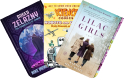
I love the painting of the Dutch
Golden Age for its humanity. All of life is there in its calm domesticity.
In
Dutch hands, even a tied bunch of asparagus attains the luminosity of an
Assumption, as Laura Cumming reveals as she weaves a memoir of her father, also
a painter, with the story of Carel Fabritius, the artist of The Goldfinch, most
of whose work was destroyed in the same sudden moment as his life in an
accidental munitions explosion in Delft in 1654.
Thunderclap offers a salutary
reminder that life comes at you fast – and death too – and that we should use
the little time we have to look at our world.
'Brilliant ... rush out and buy it' Edmund de Waal, author of The Hare with Amber Eyes
A stunning new memoir of a life in art, a father and daughter, and what a shared love of a painting can come to mean.
'We see with everything that we are'
On the morning of 12 October 1654, a gunpowder explosion devastated the Dutch city of Delft. The thunderclap was heard over seventy miles away. Among the fatalities was the painter Carel Fabritius, dead at thirty-two, leaving only his haunting masterpiece The Goldfinch and barely a dozen known paintings. The explosion that…
The eponymous hero and his brothers
embark on an oversexed tropical Homeric epic that builds into nothing less than
an origin myth of Brazil.
As in Virginia Woolf’s Orlando (also published in the same year, 1928), the trio’s
adventures collapse time and space and are notably relaxed about gender
identities. Nonchalantly metamorphosing races and species and the animate and
inanimate, Macunaíma anticipates much
later works of magical realism.
This
vibrant new translation by Katrina Dodson captures both its modernist spirit
and its authentic roots in the luxuriant rainforest.
Here at last is an exciting new edition of the Brazilian modernist epic Macunaima: The Hero with No Character, by Mario de Andrade. This landmark 1928 novel follows the adventures of the shapeshifting Macunaima and his brothers as they leave their Amazon home for a whirlwind tour of Brazil, cramming four centuries and a continental expanse into a single mythic plane. Having lost a magic amulet, the hero and his brothers journey to Sao Paulo to retrieve the talisman that has fallen into the hands of an Italo-Peruvian captain of industry (who is also a cannibal giant). Written over six…
A touching and sympathetic
biography of one of Europe’s greatest twentieth-century writers, best known as
the author of The Radetzky March, and
an essential introduction to his other novels (too little read in English).
We
follow Roth as he flits between Europe’s cultural centres, his melancholy mood
tracking the decline of the Austro-Hungarian empire. With Pim as our guide, it
is impossible not to sense the fragile state of more contemporary political
unions, as Roth’s plight in a way becomes our own.
The first English language biography of the great European writer Joseph Roth, exploring his genius and his tragic life story, lived in the shadow of war.
The brilliant, mercurial, self-mythologising novelist and journalist Joseph Roth, author of the European 20th century masterpiece The Radetzky March, was an observer and chronicler of his times. Born and raised in Galicia on the eastern edge of the Austro-Hungarian Empire, his life's decline mirrored the collapse of civilised Europe: in his last peripatetic years, he was exiled from Germany, his wife driven into an asylum, and he died an alcoholic on the eve of…
Huygens was the greatest scientist during the vital period between Galileo and Newton when the scientific revolution was gathering pace. He discovered Saturn's ring, invented the accurate pendulum clock, and devised a wave theory of light far ahead of its time.
Even more than Newton, he can be called the father of modern science, not only for his introduction of rigorous mathematics into the analysis of problems in physics but also for his central role in building the pursuit of science as a Europe-wide collaborative project.
Huygens, a Dutchman, became the leading light of the French Academy of Sciences and the first foreign fellow of the Royal Society of London. 'The world is my country, science my religion,' he once said.