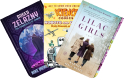
I live and breathe nonfiction about animals. Every now and then, I get smacked in the face by a book like this, a book that reminds me just how powerful fiction can be.
In these short stories, Kolluri takes on the perspective of animals from real-life news items, like when a zookeeper painted his donkey to look like a zebra, or when the zoo in Gaza was destroyed by Israeli bombs in 2014, and embodies their minds and spirits.
In nonfiction about animals, writers work hard to avoid anthropomorphizing the creatures they write about, but in fiction, Kolluri embraces it, and, I’d argue, because of it, she creates more space for empathy and understanding, connecting human readers to their non-human kin.
Longlisted for the PEN/Robert W. Bingham Prize for Debut Short Story Collection, Aspen Words Literary Prize, and the Andrew Carnegie Medal for Fiction. Finalist for the 2023 Carol Shields Prize for Fiction.
A Ms. Magazine, Bustle, Publishers Weekly, Chicago Review of Books, Debutiful, and ALTA Journal Best Book of September
An Orion Best Book of Fall
In nine stories that span the globe, What We Fed to the Manticore takes readers inside the minds of a full cast of animal narrators to understand the triumphs, heartbreaks, and complexities of the creatures that share our world.
As I said above, I love reading nonfiction about animals, and I think
of this book as the animal
nonfiction book of the past year. In his typical brilliant fashion, Yong digs into the nitty gritty science of the different ways all kinds of species
interpret the world around them with impeccable research and detailed
interviews with experts, but at the same time, he also manages to be funny,
personable, and conversational in his tone.
Yong explains the concept of “umwelt,” the
way the world is experienced by a particular organism, and I can say without a
doubt that it has changed the way I myself experience the world.
When I walk my
dog, Seymour, now, I think about the layers of smells he must be taking in
every time he stops to sniff the ground. When I feed my pet tortoises, Terrence
and Twyla, a fresh strawberry, I think about the way the red color pops in
their vision. Looking at hawks circling above my neighborhood, I know now about
their incredible vision even from so far up. I even pause now before killing a
bug in my house, scooping it up, and carrying it outside, marveling at the way
it experiences the world. Thanks for that, Ed Yong.
'Wonderful, mind-broadening... a journey to alternative realities as extraordinary as any you'll find in science fiction' The Times, Book of the Week
'Magnificent' Guardian
Enter a new dimension - the world as it is truly perceived by other animals.
The Earth teems with sights and textures, sounds and vibrations, smells and tastes, electric and magnetic fields. But every animal is enclosed within its own unique sensory bubble, perceiving only a tiny sliver of an immense world. This book welcomes us into previously unfathomable dimensions - the world as it is truly perceived by other animals.
It sounds like this book could be another one
about non-human animals. Monsters, after all, by definition, are not human, but
this book is actually radically different from the types of books I usually
read and so perhaps that’s why it has stayed with me so long after reading it.
Instead of a book about nature, this book digs into human nature.
She examines the ways that people feel about the art they love even after the
artist, often male, always human, is revealed to be some kind of “monster.”
Looking at examples like Roman Polansky, Woody Allen, Pablo Picasso, JK
Rowling, and Michael Jackson, she asks the really hard questions: Is it
possible to still love a piece of art in the same way after it has been “stained” by the artist’s personal
story or beliefs? Are we ourselves monsters if we continue to love this art? Do
you have to be a monster to make art in the first place? How are mothers their
own type of monster, especially if they dare to protect private time away from
their families to make their own art? Will anyone still love me if I become a
monster?
These are all questions that I think anyone who has loved a movie, book, album, or painting by a problem person has had at least a passing
thought about, or really any person who has loved someone else in any way.
I
didn’t expect to laugh so much while listening to a book about such a heavy
topic (Dederer herself narrates the audiobook and does a personable and
hilarious job of it) but also to regularly feel moved to tears as well. The
line I will never forget: “What do we do
with terrible people in our lives? Nothing. We keep
loving them.”
'Funny, lively and convivial... how rare and nourishing this sort of roaming thought is and what a joy to read' MEGAN NOLAN, SUNDAY TIMES
'An exhilarating, shape-shifting exploration of the perilous boundaries between art and life' JENNY OFFILL
A passionate, provocative and blisteringly smart interrogation of how we experience art in the age of #MeToo, and whether we can separate an artist's work from their biography.
What do we do with the art of monstrous men? Can we love the work of Roman Polanski and Michael Jackson, Hemingway and Picasso? Should we love…
To own a pet is to love a
pet, and to own a pet is also, with rare exceptions, to lose that pet in time. But
while we have codified traditions to mark the passing of our fellow humans,
most cultures don’t have the same for pets.
In this book, E.B. Bartels takes us from Massachusetts to Japan, from
ancient Egypt to the modern era, in search of the good pet death, from the
traditional (scattering ashes, commissioning a portrait), to the grand (funeral
processions, mausoleums), to the unexpected (taxidermy, cloning).
The central
lesson: there is no best practice when it comes to mourning your pet, except to
care for them in death as you did in life.