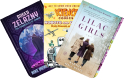
Everything ends. We know that; we might even know
that our world—this little blue-green planet—will end. But here’s the thing;
the Universe had a beginning, and it will have an end, too. That’s just
a fascinating and crazy thought; everything… ALL THE THINGS… started off for
reasons we can scarcely understand, and will eventually close up shop. It
sounds too big to contemplate, but guess what: today, right now, we can still
“see” the dawn of the cosmos. It filters into our reality as a background
noise, the ripple that flung out from creation itself, and science can measure
it!
In fact, Katie Mack writes that physicists can explain the history of the universe from the first tiny fraction
of a second until today. (You thought the dinosaurs were a long time ago?
Imagine looking at the afterglow of the Big Bang… we CAN!) I invited Katie to
join me on the Peculiar Book Club, a twice monthly YouTube livestream, to dig
deeper into the past—and future—of the cosmos. She spoke live to the audience,
answered questions, and did it all in language that made the ineffable
accessible.
That’s enough to blow my tiny human mind, but it gets even better.
Being able to see the beginning means that cosmologists can also speculate on
the end. We now have the tools to extend our knowledge into the distant future
and speculate about the ultimate fate of all reality. Will it be a “big
crunch?” Will space pull apart until nothing remains? Will everything burn
up—or perhaps suddenly cool off? Is it millions of years away? Or will it
happen tomorrow? All this and more can be found in the pages of this
fascinating book: The End of Everything.
NAMED A BEST BOOK OF THE YEAR BY THE ECONOMIST, OBSERVER, NEW SCIENTIST, BBC FOCUS, INDEPENDENT AND WASHINGTON POST
'Weird science, explained beautifully' - John Scalzi
'A rollicking tour of the wildest physics. . . Like an animated discussion with your favourite quirky and brilliant professor' Leah Crane, New Scientist
From one of the most dynamic rising stars in astrophysics, an eye-opening look at five ways the universe could end, and the mind-blowing lessons each scenario reveals about the most important ideas in cosmology
We know the universe had a beginning. But what happens at the end of the story?
Ed Yong PROBABLY needs no introduction–but just
in case: he is a Pulitzer Prize-winning science writer on the staff of The
Atlantic, where he also won the George Polk Award for science reporting,
among other honors. His first book, I Contain Multitudes, was a New York
Times bestseller.
I was SO grateful to have him live on the Peculiar Book Club
show for An Immense World. You don’t smell like a dog (I mean, of
course, you don’t understand scent!) You don’t hear like a cat whose
ears are still turned on, even in sleep. You can barely imagine the alien world
of tiny leafhoppers, each blade of grass rising like a skyscraper. In this
powerful book, Ed Yong allows us to perceive the sights, smells, waves of
electromagnetism, and pulses of pressure that surround us. We encounter bug
mating rituals, turtles that track magnetic fields, fish that speak through
electrical messages, and even humans who learn sonar, like bats (really!).
By
tuning in to the senses of animals all around us to learn just how different
the world really appears to diverse creatures. It feels as if we are seeing the
world for the very first time, with all the beauty, novelty, and strangeness
therein.
'Wonderful, mind-broadening... a journey to alternative realities as extraordinary as any you'll find in science fiction' The Times, Book of the Week
'Magnificent' Guardian
Enter a new dimension - the world as it is truly perceived by other animals.
The Earth teems with sights and textures, sounds and vibrations, smells and tastes, electric and magnetic fields. But every animal is enclosed within its own unique sensory bubble, perceiving only a tiny sliver of an immense world. This book welcomes us into previously unfathomable dimensions - the world as it is truly perceived by other animals.
Imagine
becoming mysteriously ill. Now imagine that this strange sickness has symptoms
that don’t make sense: Hives, rashes, chronic fatigue—memory loss, digestive
issues, arthritic symptoms—even seizures. Doctors ignore you. You’re told it’s
all in your head. You spend a decade or more misdiagnoses (or without a
diagnosis), watching your life turn upside down—only to discover the culprit
was a tiny bug the size of a poppy seed.
In this book by Kris Newby, we learn the secret history of Lyme Disease and Biological Weapons
to discover that maybe—just maybe—our own government might be to blame. It
reads like a riveting thriller, following the author’s own illness journey and
diving into the mystery surrounding Lyme.
Did you know that Willy Burgdorfer,
the man who “discovered” the microbe behind Lyme disease, also had a secret role
in developing bug-borne biological weapons? This unacknowledged history raises terrifying
questions about the epidemic of tick-borne diseases affecting millions of
Americans today.
A riveting thriller reminiscent of The Hot Zone, this true story dives into the mystery surrounding one of the most controversial and misdiagnosed conditions of our time—Lyme disease—and of Willy Burgdorfer, the man who discovered the microbe behind it, revealing his secret role in developing bug-borne biological weapons, and raising terrifying questions about the genesis of the epidemic of tick-borne diseases affecting millions of Americans today.
While on vacation on Martha’s Vineyard, Kris Newby was bitten by an unseen tick. That one bite changed her life forever, pulling her into the abyss of a devastating illness that took ten doctors…
"It's like Kids in the Hall
meets Muppet Show meets Morticia Addams Book Club."
It’s weird. It’s
science-y. It’s a safe haven of nerdery for all peculiar people with bizarre
interests–and best of all, you get to chat LIVE with your favorite authors from
the comfort of your Nautilus or other computer station. Hear live music, name
the week’s cocktail.
Come for the books, stay for the weird! (We have tee shirts.) If you're weird, you're family.