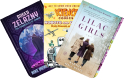
I
often read Japanese literature to access different perspectives into modern
Japanese society that diverge from news media accounts and the research that I
do. Kawakami, whose provocative Breasts and Eggs took on issues rarely
discussed in polite Japanese society, has written yet another stunning thriller
about the everyday life of a rather ordinary woman.
Encountering a traumatic encounter in her
teen years, the main character in All the Lovers in the Night is plagued
by social anxiety and chooses a profession in editing that allows her to be
immersed in language and writing.
While obliterated by demanding work finding
errors in other writers’ texts as a copy-editor, the intensity of the page
allows Fuyuko to avoid people or think about herself. Yet, her editor, Hijiri, consistently invites her out and shows her what life has to offer for
unencumbered career women about town. Fuyuko is inspired to emerge from her shell and develops a romantic
relationship with a mysterious man upon whom she projects her emotions.
Kawakami provides an intriguing plot twist in the end, leaving readers rooting
for Fuyuko and her new future.
From literary sensation and International Booker Prize-shortlisted author Mieko Kawakami, the bestelling author of Breasts and Eggs and Heaven comes All the Lovers in the Night, an extraordinary, deeply moving and insightful story set in contemporary Tokyo.
'A brief, compelling study of alienation and friendship; I binge-read it in one sitting.' - Rebecca F Kuang, bestselling author of Babel
Fuyuko Irie is a freelance proofreader in her thirties. Living alone in an overwhelming city and unable to form meaningful relationships, she has little contact with anyone other than her colleague, Hijiri. But a chance encounter with a man named Mitsutsuka…
I
was pleasantly surprised by the empathetic stories Prince Harry shared of his
closest relatives.
Especially poignant are portrayals of his father, now King
Charles, whose cultural reticence prevented him from directly expressing
affection towards his son and showed love in small touches, like notes under
pillows and stroking his hair before bedtime after Princess Diana’s horrific
accident.
Especially gripping were Prince Harry’s personal reflections when he
came to terms with a secondary role to the Throne. Enjoying traditional
masculine outdoor pursuits and initiated into hunting by “blooding” in the
Scottish Highlands, he decides on a military career which allowed meaningful
work while emulating his bodyguard role models.
The Invictus Games reflect
this physicality of pushing oneself beyond limits. Ever self-critical, Prince
Harry humanly meanders towards adulthood like many young men, whose continuing
struggles with paparazzi (labeled “paps”), blamed for killing his mother,
initially stymy achieving true happiness.
By the book’s end, we discover a
brave man who surpasses tradition to lead in bold new directions—including
controversial exposure of his family to a critical public.
It was one of the most searing images of the twentieth century: two young boys, two princes, walking behind their mother's coffin as the world watched in sorrow-and horror. As Princess Diana was laid to rest, billions wondered what Prince William and Prince Harry must be thinking and feeling-and how their lives would play out from that point on.
For Harry, this is that story at last.
Before losing his mother, twelve-year-old Prince Harry was known as the carefree one, the happy-go-lucky Spare to the more serious Heir. Grief changed everything. He struggled at school, struggled with anger, with loneliness-and,…
I often like to read graphic
novels to relax and immerse myself into other worlds. The art on the page is
entertaining and can be read in small vignettes in comparison to a full-length
film.
Hernandez’s brilliant series reads like a psychedelic telenovela enlivened
with elements of punk and surrealism, spanning the gritty streets of Los
Angeles, raunchy LA parties, memories of the Central American town of Palomar,
and the 1980s and 1990s code-switching world of Latinx southern
California.
A host of individuals from
multiple generations hailing from a melange of ethnic, racial, and
socioeconomic origins swarm around Luba, the collection’s titular character, and
compose her vast span of close, and far, relatives and chosen companions.
Hernandez inks indomitable characters
reflecting the time period, who live boldly and in constant motion, all
accompanied by their own soundtrack of garage bands, rancheras, and a host of
other tunes.
The sequel to the 2003 perennial classic, Palomar. Gilbert Hernandez climaxed his award-winning “Palomar” series at the end of Love and Rockets' original run by leveling the Central American hamlet. But he soon picked up the story of Luba: The hammer-wielding matriarch had emigrated to the U. S. where she contended not only with an unwelcoming new culture but also her extended family. These “America” stories - over 80 of them, ranging from quick one-page blackout sketches to graphic novellas - were originally published in a number of different comics and reprinted in a trilogy of oversized paperbacks. Luba collects…
As a historian of modern Japan, I
have long enjoyed immersing myself in Japanese consumer cultures in Japan and
abroad.
What makes Japanese name brands
so fashionable and appealing? How did they arrive on the global market in the
first place? Why does “Japan” currently
evoke both luxury and cool?
My book
explores why people consume the products they love and how Japanese companies
have activated this kind of consumer desire in their product advertisements. I
also investigate how a specifically Japanese form of luxury evolved in consumer
products that were high quality yet affordable.